MEGACHILE CENTUNCULARIS: LEAF-CUTTER BEES IN DORSET


Bee box on a wall, Dorset

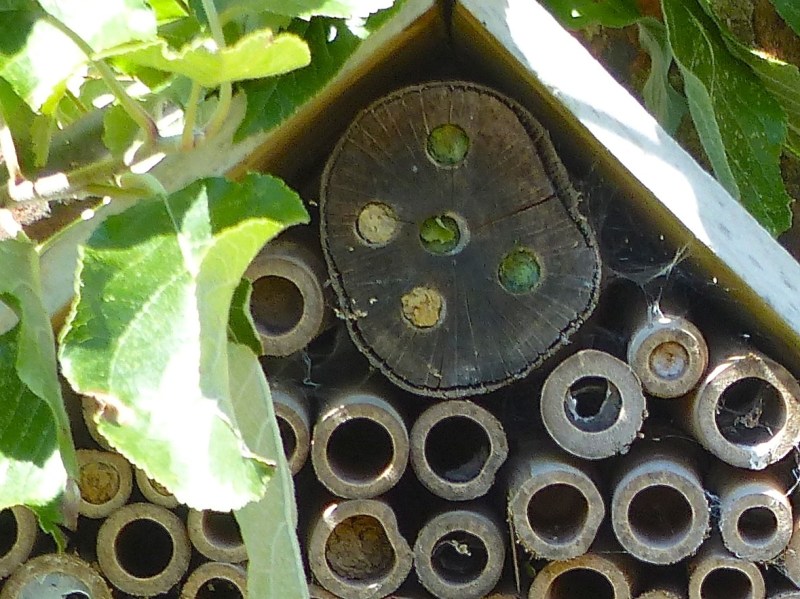
This is the first year that leaf-cutter bees have discovered the bee box placed invitingly on a south-facing wall – and only in the last month. Or maybe they had and didn’t like the box. Or the other occupants. Anyway, quite soon they had tenanted the remaining holes in the prestige penthouse log. Bee box with leaf-cutter bees, Dorset

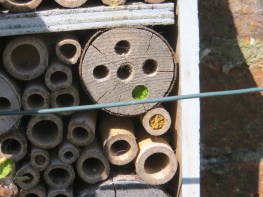
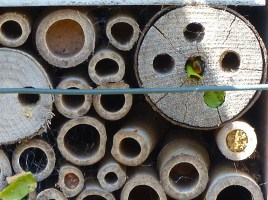
Last week, the LCBs were quite active, so from time to time I watched them. The first one was completing its work in the top-right log on the lower storey. Having packed in the leaves, it spent quite some time perfecting the job, leaving a smooth end to the bright green plug.

Bee box with leaf-cutter bees, DorsetBee box with leaf-cutter bees, Dorset

Bee box with leaf-cutter bees, DorsetBee box with leaf-cutter bees, Dorset

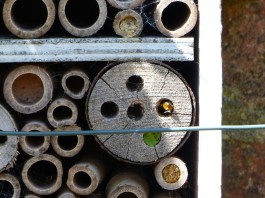
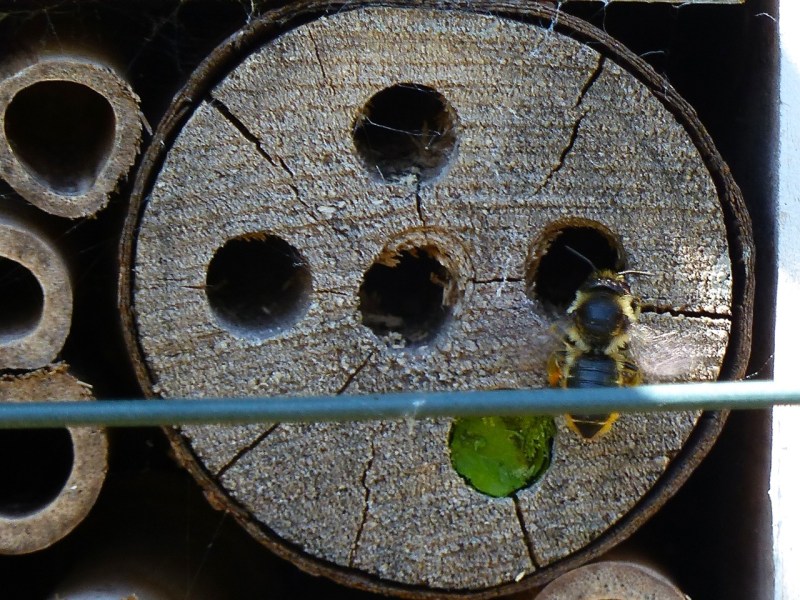
Later on I saw a bee engaged in an earlier stage of construction. It chose the same log, and initially went for the middle hole, disappearing with a strip of leaf. It then revised its accommodation plans, reversed out with the leaf and took it to the adjacent hole.

Bee box with leaf-cutter bees, DorsetBee box with leaf-cutter bees, Dorset

Bee box with leaf-cutter bees, DorsetBee box with leaf-cutter bees, Dorset

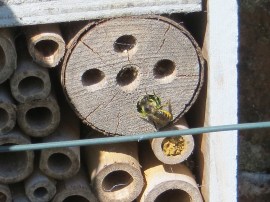
I found the bees surprisingly difficult to photograph. I had to change cameras to a ‘faster’ one, because a bee would zoom back to the hole with its leaf and dive straight in, dragging the leaf behind it; and emerge suddenly and fly off at speed. Sometimes there was a struggle to get the leaf into the hole, which helped take a shot; or I could see the bee pause in the dark but quite close to the entrance before flying off. But mostly, the comings and goings took me by surprise every time, even though I was ready for them…

Bee box with leaf-cutter bees, DorsetBee box with leaf-cutter bees, Dorset

I checked the plants in the vicinity for the tell-tale semi-circles cut out of the leaves. They seem to have liked a nearby rose and another plant whose name I forget (if I ever knew). They use saliva to glue the cuttings together to build the cells for their larvae. The larvae have a safe place to hatch and develop. They pupate in the autumn and hibernate during the winter. Now that the leaf-cutters have found the box, we are hoping that next year the new generation will go through the whole process again. And that I will be more handy with the camera.

NOTE: I see that these bees are often called Leafcutter bees, or Leaf Cutter bees, whereas I have plumped for a hyphen. I’m going (having retrospectively checked) with the Natural History Museum’s version…

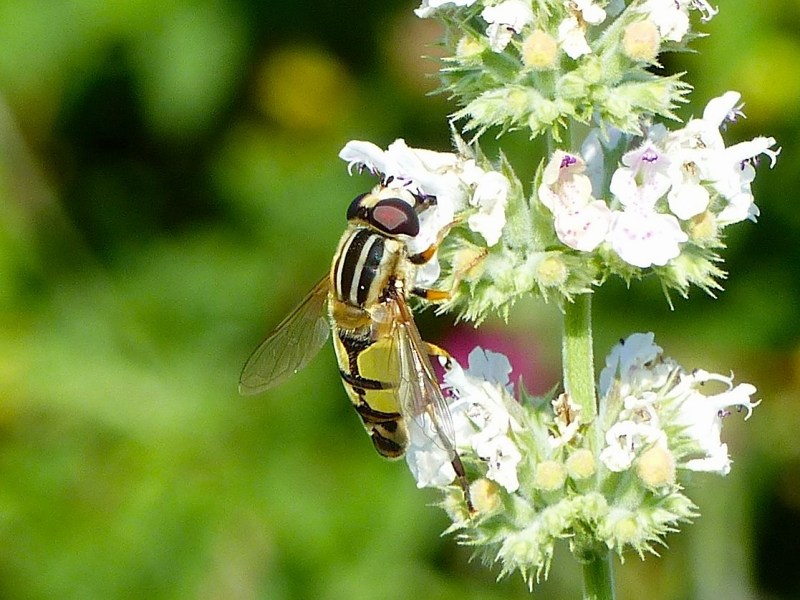
HOVERFLY IN DORSET (Helophilus trivittatus)


Hoverfly (Helophilus trivittatus) Dorset 15

While photographing bees last week I encountered a smartly marked hoverfly.  I was particularly impressed by its striped head. I have to admit that until I looked into it, I has assumed that there were maybe half a dozen different species in the UK. I’ve never really examined them closely until this one flew into my lens range.

Hoverfly (Helophilus trivittatus) Dorset 13

How wrong I was. Fortunately by googling ‘hoverfly ID’ my first hit was a wonderful site about the natural history of Rutland and Leicestershire called NATURESPOT.  The link will take you to their hoverfly page, from which you will learn that “There are over 280 species of hoverflies in Britain and around 140 of these have been recorded in Leicestershire and Rutland”.

Hoverfly (Helophilus trivittatus) Dorset 14

Additional useful information includes this lightly edited précis:

  • Many have black and yellow markings and are often confused with bees and wasps
  • Hoverflies are totally harmless and are definitely a gardener’s friend
  • The larvae of several common species have a voracious appetite for aphids
  • Very few hoverflies have common names
  • Those that exist (e.g. “The Footballer”) are not always widely known or agreed
  • However the Latin names of all the species are accepted

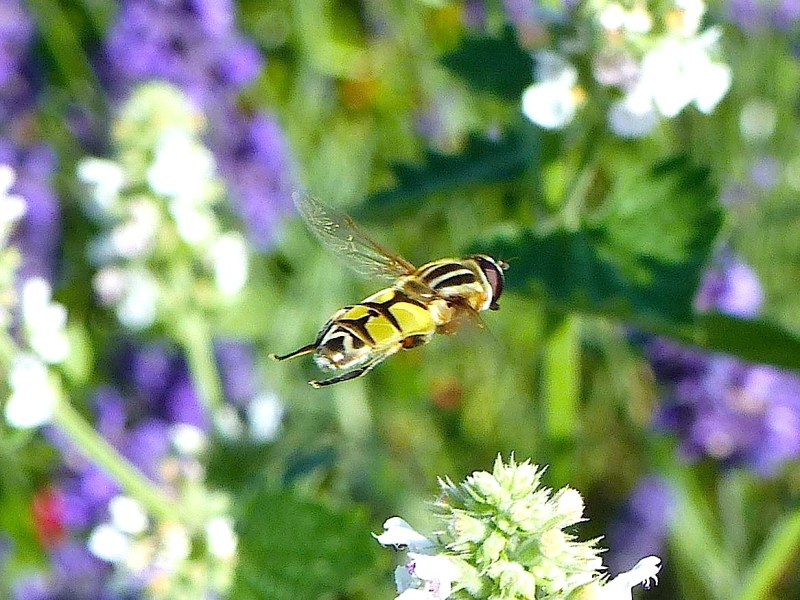
Hoverfly (Helophilus trivittatus) Dorset 18

This is the best (though somewhat average) in-flight shot, included to show the trailing back legsHoverfly (Helophilus trivittatus) Dorset 03

I had to scroll quite far down the hoverfly page to reach the striped-headed ones. Here’s a clip of the part that I used for a clear ID as Helophilus trivittatus. I highly recommend Naturespot not just for hoverflies, but for many different species. It may be local to a specific area, but it is a mine of information for the UK generally, and very well organised.

IMG_1478

Hoverfly weblink: http://www.naturespot.org.uk/taxonomy/term/19415