THE SUNDIALS AT LITLINGTON CHURCH, EAST SUSSEX (2)


Litlington Church, East Sussex: the sundials (Keith Salvesen)

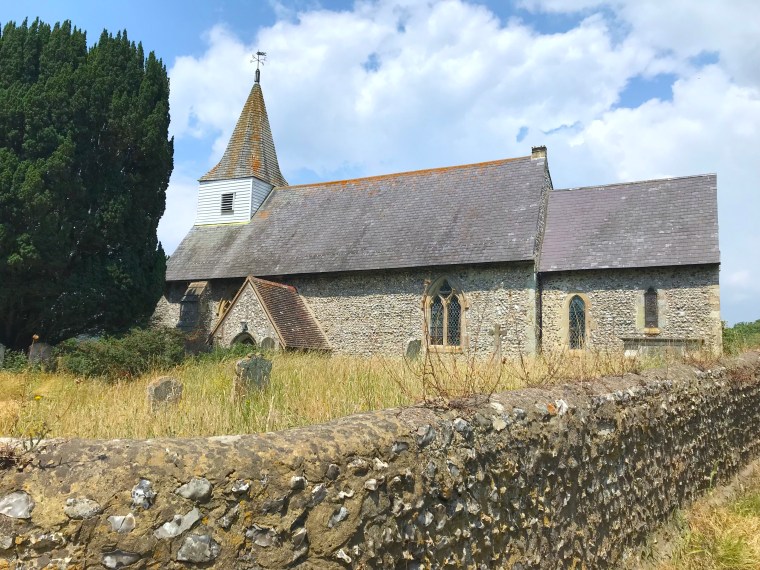
The remarkable, sophisticated and possibly unique scratch dial on the face of the church porch that I recently featured HERE is not the only dial on this attractive Sussex Church. Almost unremarked are what are passingly mentioned in the only two references I have found online as ‘two further sundials on a north buttress’ (a nod here to the Eastbourne Church Recording Group). These dials do not even appear in the British Sundial Societys list of mass / scratch dials (though they do feature the main dial on the porch). 

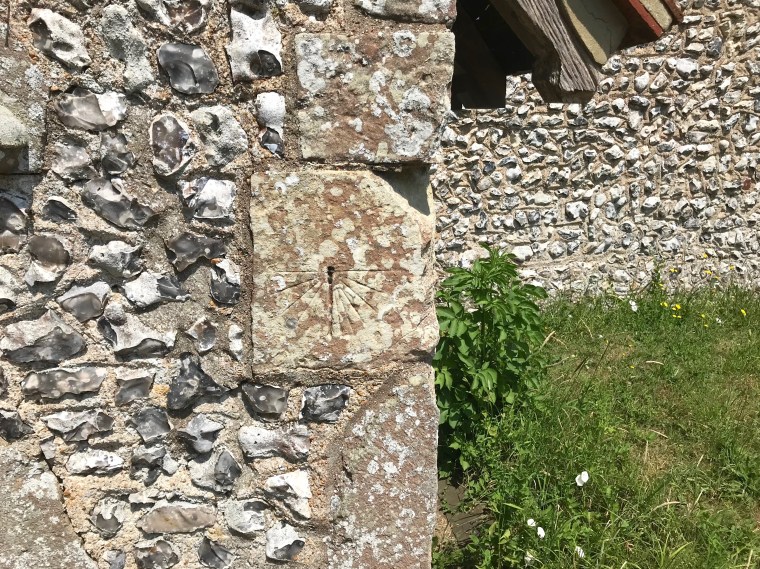
DIAL ONE – NORTHEAST FACE

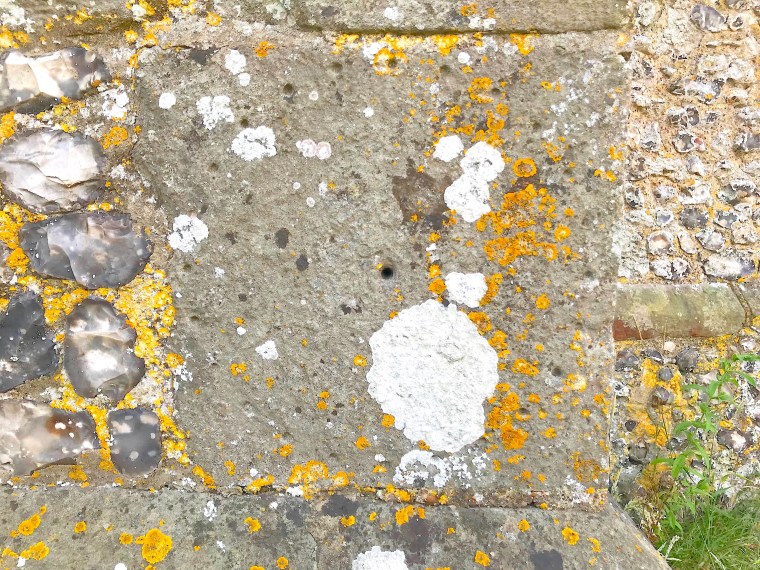
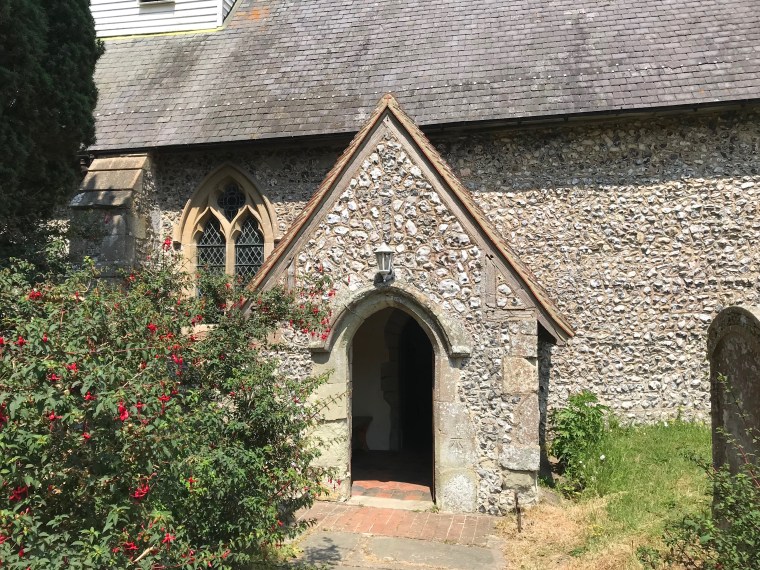
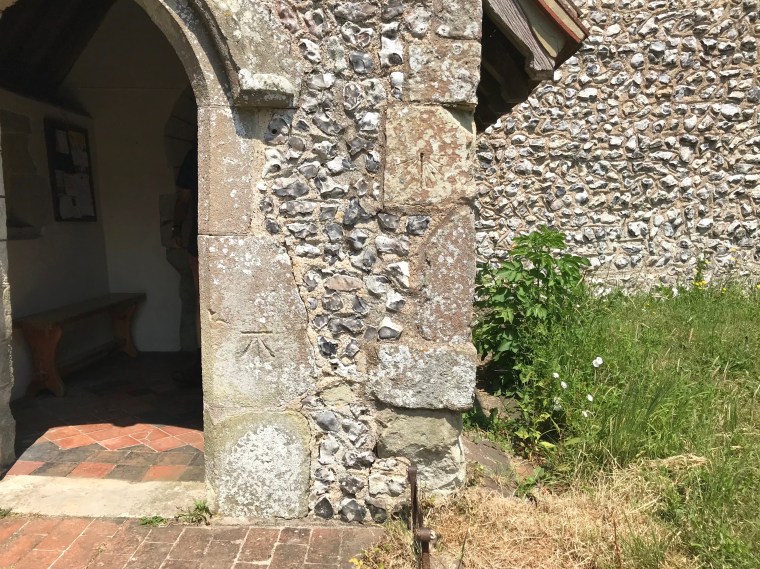
Having been told about the three – three! – dials, I was fairly confident when I set out to search for them. The first one – on the porch – was easy, not least because it was on the most obvious, south-facing, location possible. Then the trouble started. Without the Church Warden’s aid, I’d never ever have found the other 2. Who would guess that the dials would be (a) on the north side, (b) a couple of feet off the ground and (c) set at a 90º angle to each other on the same stone block in a buttress. 

Litlington Church, East Sussex: the sundials (Keith Salvesen)

Northeast Face (1)Litlington Church, East Sussex: the sundials (Keith Salvesen)

In the absence of any other information, dating these dials is very hard. The church dates from c1150. These dials, almost identical in construction as far as one can tell, are clearly simpler and far cruder than the main dial on the porch that is dated to the c15 and is transitional in scratch dial design between showing canonical hours and the ‘modern’ 24 hour clock. Yet both dials are full circles, and have 24 ‘dots’ surrounding the central hole for the pointer – notwithstanding that only the ‘daytime’ area on each dial is functional in practice. As far as I can make out, this is not an unusual arrangement.

Northeast Face (2)Litlington Church, East Sussex: the sundials (Keith Salvesen)

Litlington Church, East Sussex: the sundials (Keith Salvesen)

DIAL TWO – NORTHWEST FACE

Litlington Church, East Sussex: the sundials (Keith Salvesen)

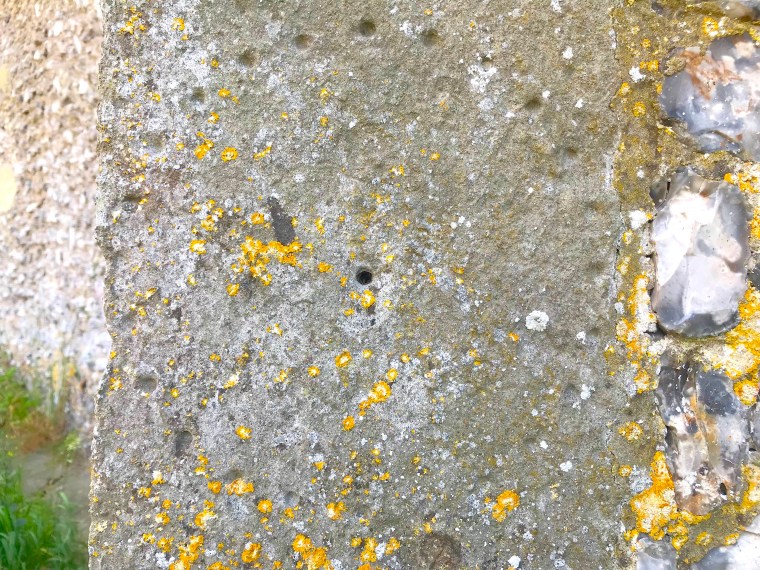
It’s hard to find any significant difference between this dial and its adjacent counterpart, other than the direction faced. I didn’t make any measurements, but this 24 dot dial seems smaller, not least because the available space on this face is less. The assumption must be that both dials were made at around the same time, presumably to catch the early morning and late afternoon sun. I’ve no idea why they were located so low on the building, since there are higher cornerstones on this buttress that would have done as well – and perhaps have been more readable at eye-level.

Litlington Church, East Sussex: the sundials (Keith Salvesen)

Sundials are an interest but very far from a speciality for me. If anyone can shed any light on dials of this sort – date, construction / design, location on the building – please comment on this post, or email me at rollingharbour.delphi [at] gmail.com. And if you know of a similar dial, please get in touch.
Litlington Church, East Sussex: the sundials (Keith Salvesen)

RELATED POST
LITLINGTON SUNDIAL 1

All photos Keith Salvesen / Rolling Harbour

THE SUNDIALS AT LITLINGTON CHURCH, EAST SUSSEX (1)


St Michael's Church, Litlington East Sussex (Keith Salvesen)The majority of churches have no integral sundial. Those that do are usually content with one; some may supplement that with a standing sundial in the churchyard. Very few have three sundials that are integral to the building itself and to its history. The small church of Litlington East Sussex is one such. It also has a large benchmark on the porch, and three superb bells dating from the early c15. The main sundial is easy to spot; the other two are far less visible. I spent sometime looking for them in vain, until the church warden took pity on me. But (*spoiler alert*) whoever would expect to find sundials low down on a north wall? They deserve a post in their own right, which will form part 2. They are so far undocumented as far as I can see, except locally.

St Michael's Church - the porch. Litlington East Sussex (Keith Salvesen)The church dates from c1150, and was restored in the mid-c19. The porch is where the quest for the main sundial ends – the benchmark, too. 

St Michael's Church - sundial & benchmark. Litlington East Sussex (Keith Salvesen)
A close inspection shows just how unusual this scratch dial is – quite possibly unique. The only full account of it that I have found appears in an article by W. Oliver published in SCM* Volume 12 1938  Page 529The link is given below.
St Michael's Church, Litlington East Sussex (Keith Salvesen)

There are 3 features that immediately stand out: the deep ‘furrow’ at 12 noon; the confusing style / pointer holes; and in particular the carefully graduated hour markings. 

An improvised biro ‘style’ indicates the correct timeSt Michael's Church, Litlington East Sussex (Keith Salvesen)

A REMARKABLE DIAL

W. Oliver makes several points in his article, which distilled come to this:

  • This is a scratch dial typical of Saxon times and the middle ages, incised on the building stones
  • The design (for the period) is “most exceptional, if not unique” among the 1400 recorded church scratch dials
  • Other dials have equally spaced hour-lines that cannot measure time accurately, and certainly not year-long (though pointer adjustments could be made to compensate) 
  • These were primarily intended to indicate the 5 Canonical hours for prayer, not time
  • Extra lines were sometimes added, as time measurement became more sophisticated
  • At Litlington, exceptionally, the hour-line spacing is ‘scientific’ to enable accuracy
  • The lines are carefully graduated down to and up from 12 noon
  • This scientific approach is very much as seen on modern vertical sundials
  • The usual hole for a style / pointer is supplemented by the deeper groove at noon
  • This suggests there was at some stage a slanting gnomon, as found on modern wall dials
  • This could have been set to the latitude of Litlington to ensure year-round accuracy
  • The Litlington scratch dial may in fact be the only one able to tell the time properly

Church Sundial at Litlington By W. Oliver  http://www.massdials.org.uk/texts/scm12.htm

Do the 3 holes support the theory of an added gnomon fixed below the original style hole?St Michael's Church, Litlington East Sussex (Keith Salvesen)

DATING THE DIAL

W. Oliver does not give a date for the dial, other than ‘Middle Ages’ (it’s clearly not as old as Saxon). In a website called https://www.bestofengland.com the entry for this church states “Outside there is still a 13th century sundial on the porch”. This dating seems to have caught on and appears in e.g. Tripadvisor descriptions.

The local website http://www.litlington.info/st-michael-the-archangel-church-litlington says “Outside, on the porch, is a 15th century scientific sundial…” Given the sophistication of the Litlington dial, the first date seems clearly wrong and the second must be the preferred date. It also fits in with date of the installation of the earliest bell – perhaps a time of general improvements to the church. Even so, in the light of W. Oliver’s analysis, the dial shows an extraordinary understanding of the principles of recording time accurately that is apparently absent in the 1399 other instances of scratch dials in the country. The British Sundial Society has a short entry (see below) for this dial (and none for the other two at the ‘back’ of this church, mentioned earlier), including a reference to a polar gnomon. No mention of a possible date, but I take ‘transitional’ to mean between the era of marking the Canonical Hours and the gradual move to a 12 / 24 hour clock as the standard for time-telling.

BRITISH SUNDIAL SOCIETY

The brief entry states “The dial can be seen to the right of the porch. All hour lines 6am – 6pm, but no numbers or any trace that there ever were any. Lines correctly delineated for a polar gnomon. No trace of old lines, so possibly not a re-cut mass dial. 310 diam. semicircle. Transitional dial? Ref. C Daniel, Sundials, Shire Album 176,1986, p5 Location 50°47’50″N, 0°9’34″E;  National Grid: TQ 523 020″

The illustration to W. Oliver’s article

Any comments about this remarkable dial would be welcome.

Research as specified / linked. * = Sussex County Magazine. The Litlington website entry is as recorded by the Eastbourne Church Recording Group between 2007/2009. All photos Keith Salvesen / Rolling Harbour except as indicated

ARMILLARY SPHERE SUNDIAL: KINGSTON LACY, DORSET

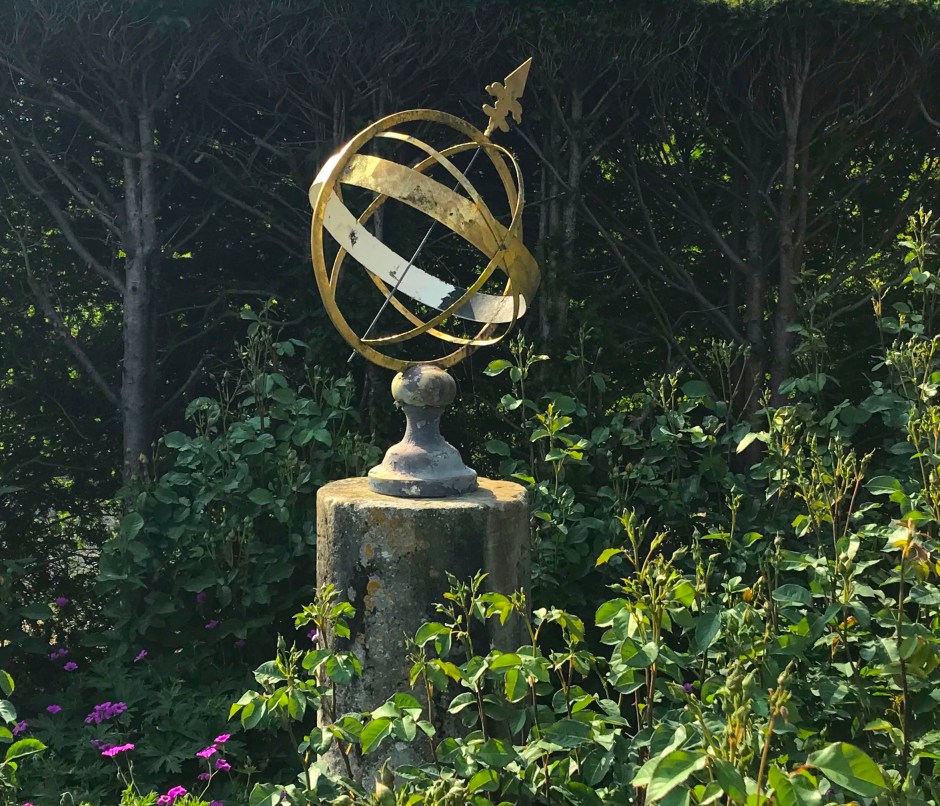
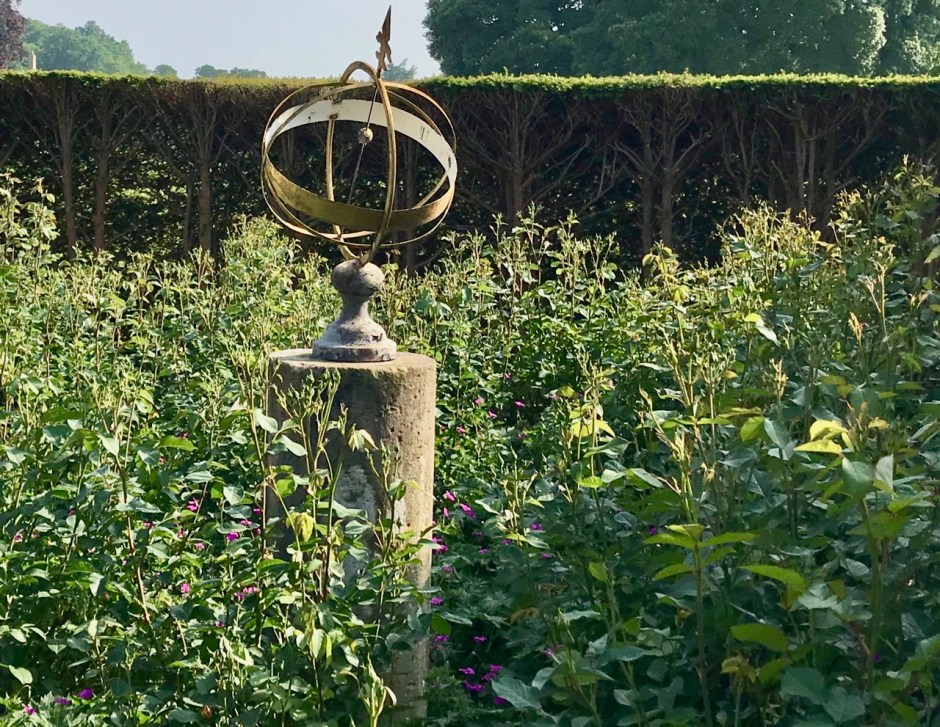
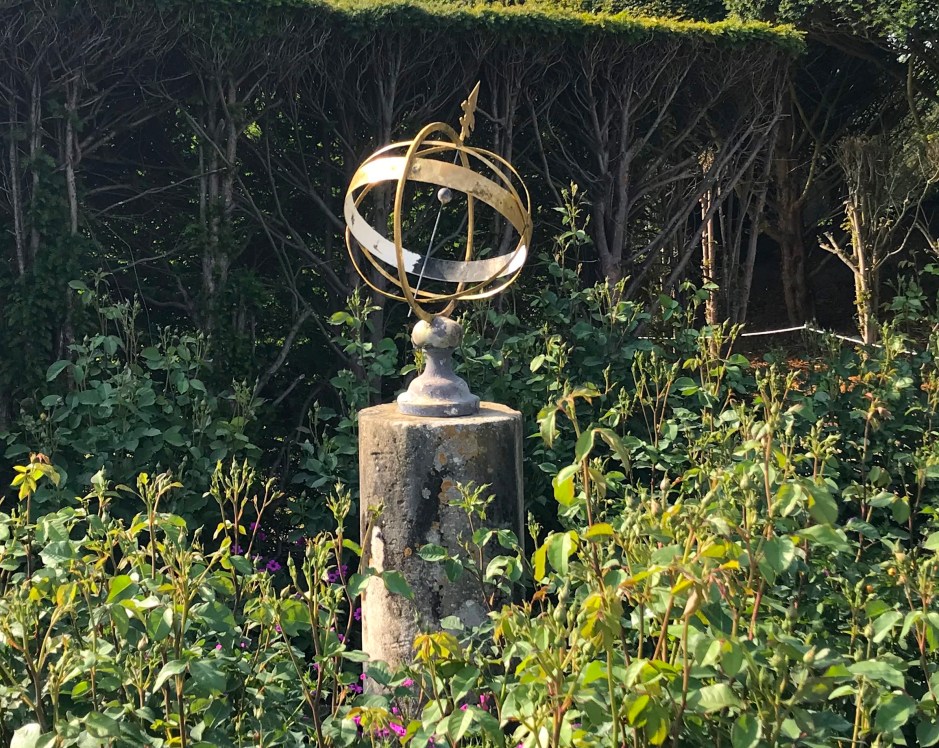
ARMILLARY SPHERE SUNDIAL: KINGSTON LACY, DORSET (Keith Salvesen)

This enjoyable armillary sphere at Kingston Lacy stands proudly on a tall stone baluster in the middle of a rose garden. I wanted to get close to it to look for markings, few of which were visible at a distance. However the lush spring growth deterred closer investigation, and I preferred to leave it inspected. It is not included in Historic England’s detailed descriptions of the house and garden. A photograph found online suggests that the sundial was at one time located elsewhere in the garden, near a wall. I need to try a bit harder to find a date for it.

ARMILLARY SPHERE SUNDIAL: KINGSTON LACY, DORSET (Keith Salvesen) ARMILLARY SPHERE SUNDIAL: KINGSTON LACY, DORSET (Keith Salvesen) ARMILLARY SPHERE SUNDIAL: KINGSTON LACY, DORSET (Keith Salvesen) ARMILLARY SPHERE SUNDIAL: KINGSTON LACY, DORSET (Keith Salvesen) ARMILLARY SPHERE SUNDIAL: KINGSTON LACY, DORSET (Keith Salvesen)

All photos: Keith Salvesen Photography

A STAINED GLASS SUNDIAL AT TOLLER PORCORUM, DORSET


Toller Porcorum is an archetypal Dorset village, right down to a latinate name redolent of medieval swine-herding (cf Ryme Intrinseca, Kington Magna etc). The fine Church of St Peter and St Andrew lies at the heart of the village, and is also very ‘Dorset’. 

Toller Porcorum Church, Dorset (Nigel Walden / Geograph)

While I was fishing on the nearby River Frome a couple of weeks ago, Mrs RH visited some churches in the area, including this one. Inside, she noticed an unusual modern ‘glass sundial’ set in a stained glass window, a marker of the hours and the millennium.  

Toller Porcorum Church, Dorset - Stained Glass Sundial

Knowing that sundials are one of the features on this blog, she took a few photographs with her phone. They have come out very well. 

Toller Porcorum Church, Dorset - Stained Glass Sundial

In the close-up above, you can just make out the shadow of the gnomon at approx 12.40 (midday being at the bottom). On the outside the gnomon, in the right-hand window (below), is elegantly simple and  unobtrusive. The close-up shows it more clearly. But of course the effect is meant to be seen from the inside, if only to time the length of the sermon.

Toller Porcorum Church, Dorset - Stained Glass Sundial

Toller Porcorum Church, Dorset - Stained Glass Sundial

Lordy, but I am negligent of this site. Thanks you, kind people who still come to look at stuff  here even though (I am ashamed to note) my last post was in November 2017. I’m going to try to get back on track with this side-project… there’s quite a backlog of material!

AN UNUSUAL MAZE AT PAUL, CORNWALL & A VIEW TO DIE FOR


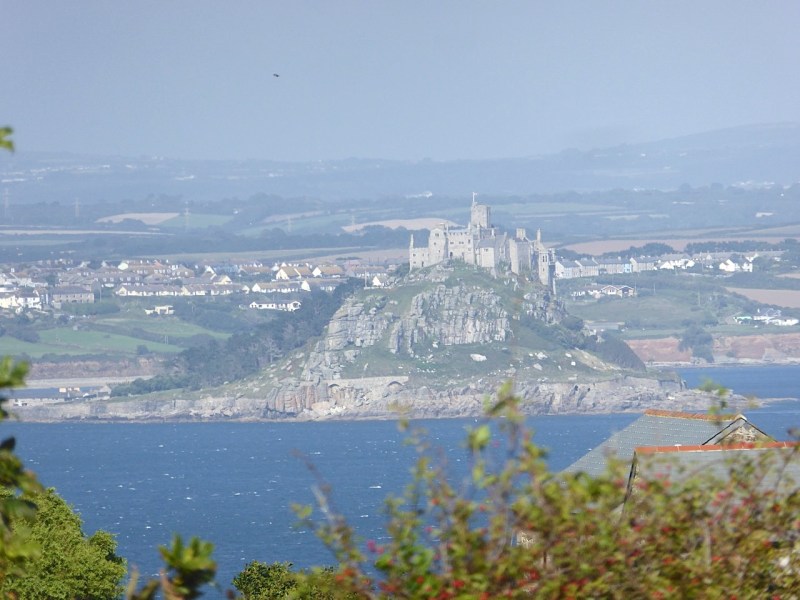
St Michael's Mount from Paul Churchyard, Cornwall (Keith Salvesen)

Paul is a small village west of Penzance, Cornwall. It sits high on the hill above its more famous neighbour, Mousehole. Paul’s historic parish church, St Pol de Léon, has origins reputedly dating from late fifth century. The medieval building was (to my ignorant surprise) badly damaged in a raid by the Spanish in 1595, several years after the Armada. Mousehole also suffered great damage in the same raid. Until visiting Paul this summer, I had no idea that the Spanish had ever managed to breach England’s defences. So I checked online and was quickly led to the BATTLE OF CORNWALL, of which I had never heard. So now I know… I hope Hispano-Kernowek relations have improved.

Paul, Cornwall: the extended churchyard (Keith Salvesen)

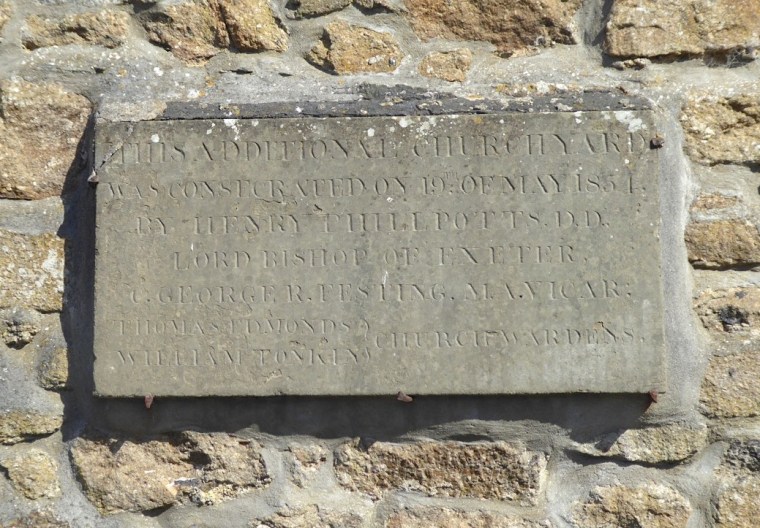
The Church merits its own post in due course. For the moment, the maze-collector in me found a different interest in a nearby extension to the churchyard. An engraved stone set into a wall, and a small diagram nearby, led me to a path and a large area of hillside with extensive views out to sea, and east towards St Michael’s Mount.  

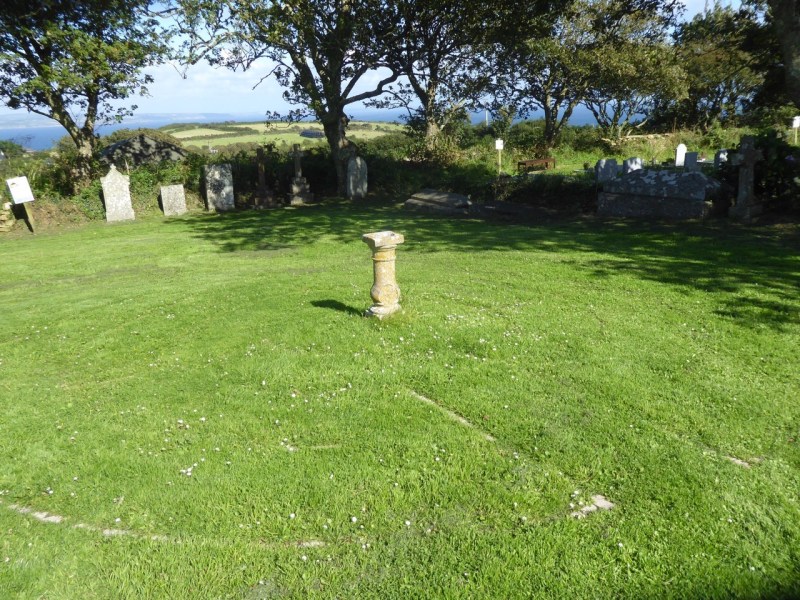
Near the more recent gravestones was a sundial; and closer inspection revealed that it was at the centre of a small, overgrown maze outlined on the grass in granite. How I longed, interferingly, to have a strimmer handy. But apart from tracing some of the pattern with my foot, I restrained my quite unreasonable urge to disclose the maze…

Paul Churchyard Cornwall: sundial & maze (Keith Salvesen)Paul Churchyard Cornwall: sundial & maze (Keith Salvesen)Paul Churchyard Cornwall: sundial & maze (Keith Salvesen)


A SUNDIAL AT CHASTLETON HOUSE,


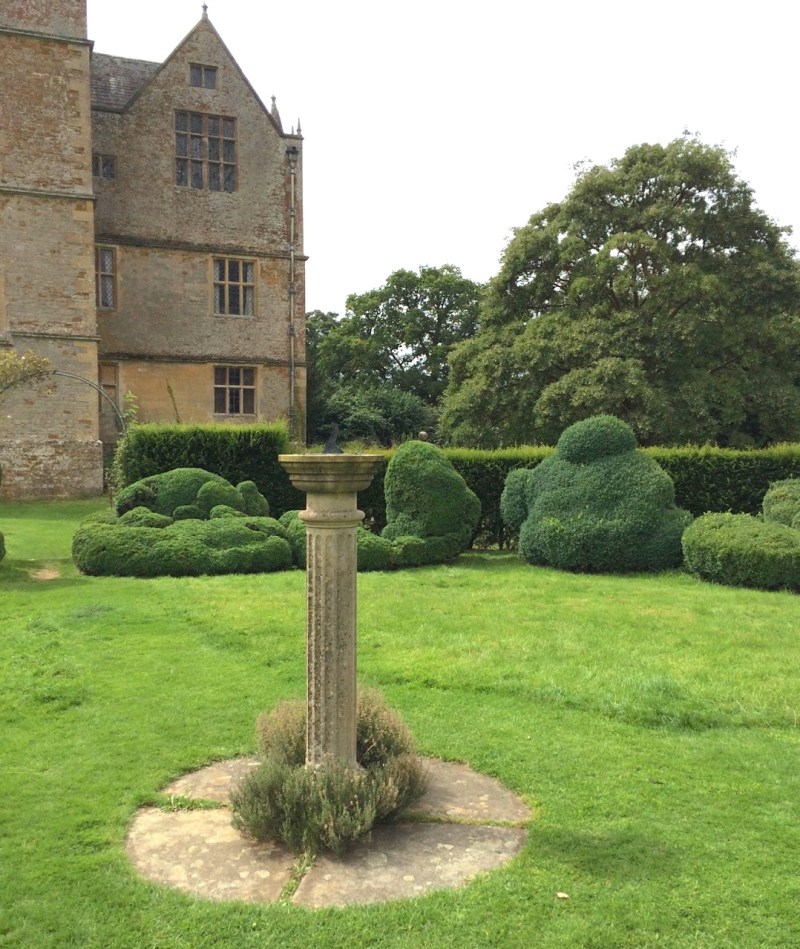
Chastleton House, Oxfordshire: the Sundial

Chastleton House is a fine Jacobean house in Oxfordshire dating from the early c17. In 1991 it was acquired by the National Trust, having been owned by the same family for some 400 years. Its most recent claim to fame is to have featured as ‘Wolf Hall’ in the recent BBC series.

Chastleton House, Oxfordshire: the Sundial

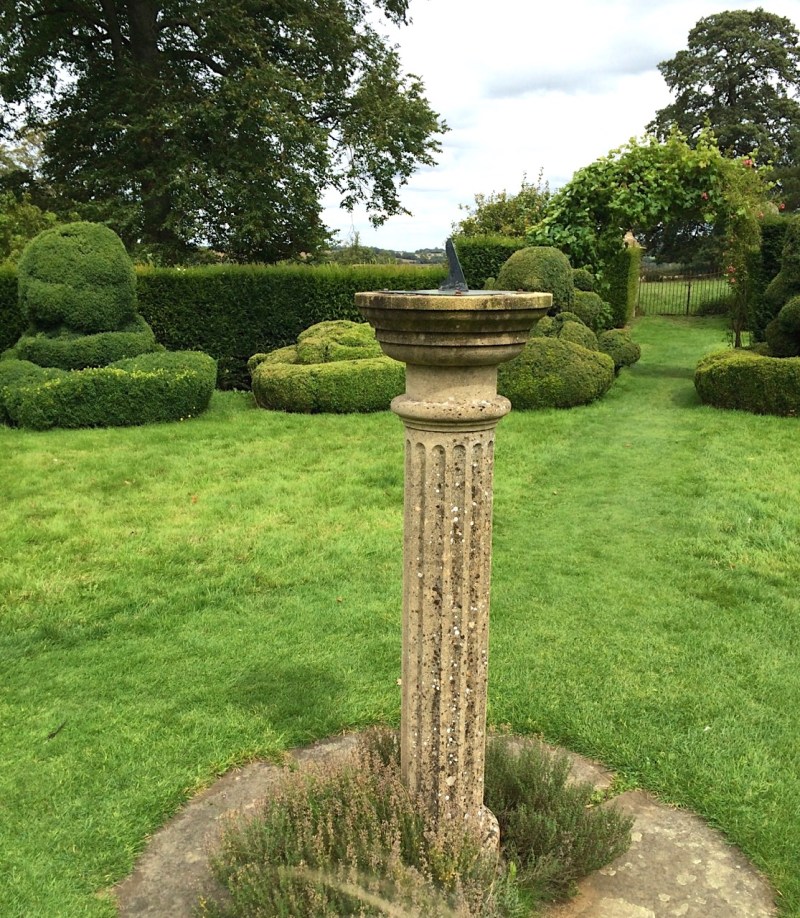
There are fine gardens at Chastleton, kept pleasantly unmanicured. And there is a sundial. I can’t find a date for it – the NT does not give one – but I like the unusually tall slender column that supports the dial.

Chastleton House, Oxfordshire: the Sundial

I was hoping to find some more information online, with little luck. I found a photograph that showed the dial unfixed from the base, and clearly some restoration has been done to remedy that. I’m not sure the rusting bolts were ideal. If I find any other information I will add it in due course.

Chastleton House, Oxfordshire: the Sundial

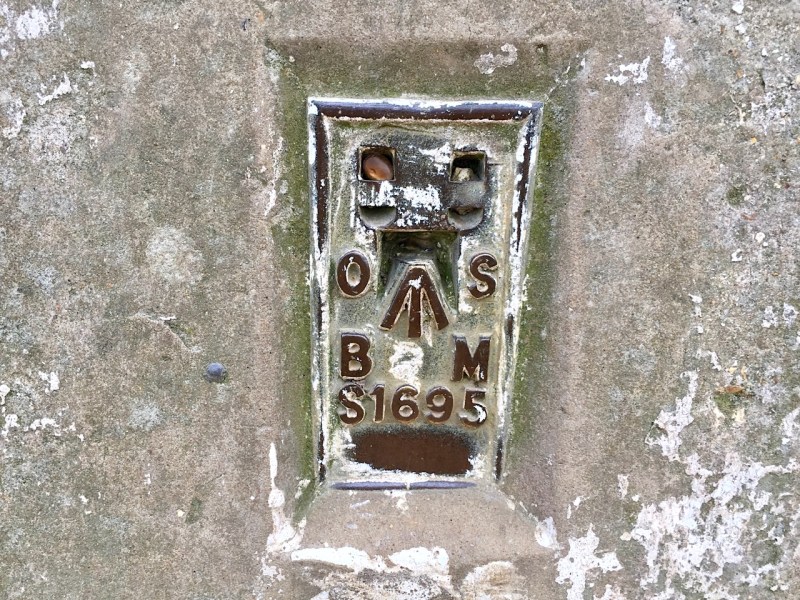
DANEBURY TRIG POINT S1695, HAMPSHIRE


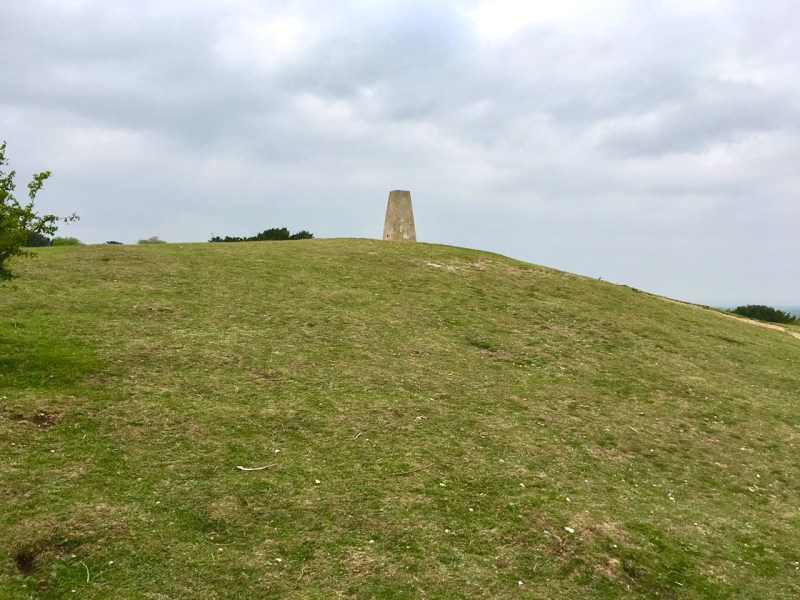
Danebury (or ‘Danebury Rings’) is an Iron Age hill fort in Hampshire. The hill is 143 m (469 ft) in height, not spectacular in itself but its prominence in the landscape gives clear, distant views in all directions over the county and beyond. The fort itself covers around 12 acres, and was extensively excavated in the 1970s. The evidence suggests it was built in the c6 BC, and was used for some 500 years. 

Danebury Trig Point S1695

We hadn’t walked on Danebury for many years, though we drive past it frequently. When we set off for a walk there, I didn’t even know about the trig point – though the location makes perfect sense for one. I had no camera with me, just an iPhone. On a chilly, cloudy May day, these photos will at least give some idea of the extensive views from the Trig Point across the patchwork of fields. Next time, we’ll choose a clear sunny day for a walk there…

Danebury Trig Point S1695Danebury Trig Point S1695Danebury Trig Point S1695Danebury Trig Point S1695Danebury Trig Point S1695Danebury Trig Point S1695 - the plate

CLOSWORTH CHURCH, SOMERSET: A TOMB & A SUNDIAL


Closworth, a small village on the Somerset / Dorset border, has a fine church with c13 origins. The village itself is best known for its historical importance as a bell-foundry between the c16 and c18, originating with the Purdue family. Few traces of the foundry remain, but some notable bells survive from its earliest days, for example in Wells Cathedral.

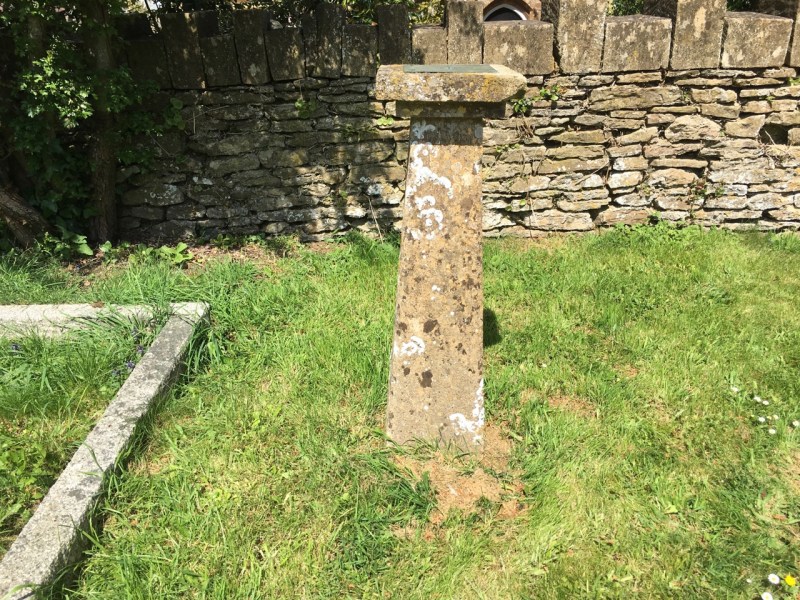
A quick visit to the church revealed two items of interest for this blog: a fine early c17 tomb; and an agreeable but gnomon-less sundial of uncertain date.

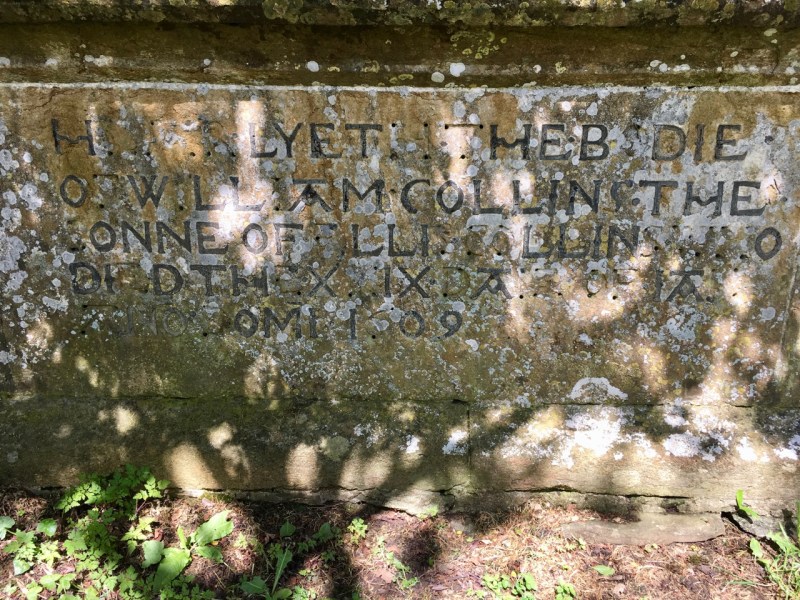
TOMB OF WILLIAM COLLINS, 1609

HERE . LYETH . THE . BODIE .
OF . WILLIAM . COLLINS . THE .
SONNE . OF . ELLIS . COLLINS . WHO
DIED . THE . XXIX . OF . IAN
ANO . DOMI . 1609

The inscription on this lichened hamstone tomb is in leaded letters set into the stone and fixed. Not all have survived the intervening centuries. I have no idea how this was achieved, but presumably the lettering was first cut into the stone; and with the stone on a horizontal surface the lead was then added to fit the incisions, and pinned in place. The result is pleasingly rustic, with some ornamentation of the As and Hs. This type of inscription-work may not be particularly unusual, but seeing this ancient tomb dappled by sunlight on a spring day made it seem special. And I always enjoy ornamental dates.

Tomb 1609. All Saints Church Closworth, Somerset Tomb 1609. All Saints Church Closworth, Somerset Tomb 1609. All Saints Church Closworth, Somerset

SUNDIAL: ALL SANTS CHURCH, CLOSWORTH

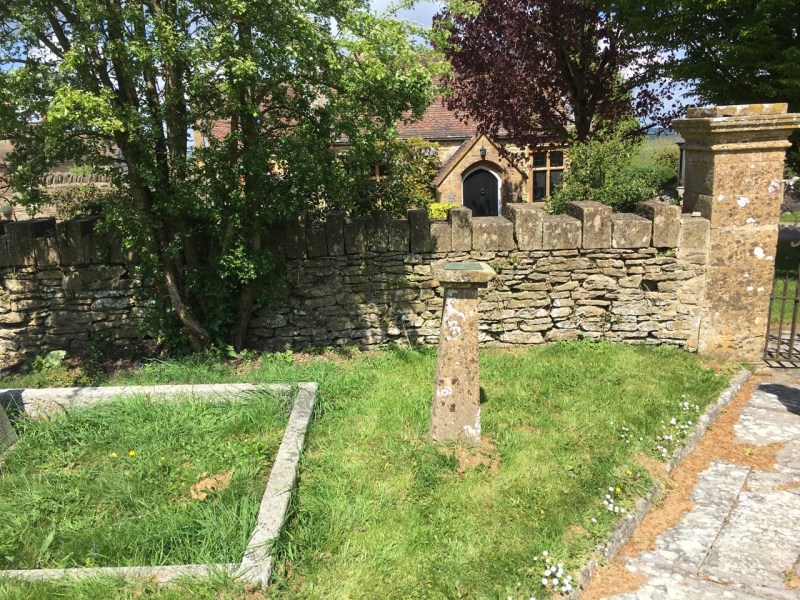
We didn’t notice the sundial on the way into the churchyard. Our attention had been drawn to a tall memorial to the other side of the path. On the way out, it was of course obvious – as was the lack of a gnomon. Like the tomb and the gateposts, the pillar appears to be made from the local hamstone. There isn’t much information to be gleaned from the dial itself. There’s no maker’s mark (though sometimes those are hidden on the underside of the plate). At a guess, it is c19, but any comments would be welcome.

Sundial, All Saints Church Closworth, Somerset Sundial, All Saints Church Closworth, Somerset Sundial, All Saints Church Closworth, Somerset Sundial, All Saints Church Closworth, Somerset

‘UNEXPECTED TIMES’: A SUNDIAL ON THE PONTE VECCHIO


sundial-ponte-vecchio-florence-4

Florence in January.  -8°C at night, zero during the day – but sunny enough in the middle of the day to be able to have coffee or even lunch outside. Apart from the Uffizi, no queues for anywhere. Most significant places on the tourist trail almost to oneself. Despite the cold, there is no frost: the air is so dry that the pavements, piazzas and even the cars are quite clear of frozen white crystals. By the river I caught the electric flash of a male kingfisher flying up from the water to an overhanging bush, his hunting perch. I watched him as he scanned the water below, occasionally diving down and returning to the same branch. Twice, I could see the glint of a tiny fish in his beak. 

sundial-ponte-vecchio-florence-5

Since I was 17 I have been lucky enough to visit Florence quite often, not least because Mrs RH regularly goes there on business, and I am a keen ‘trailing spouse’. Over the years I don’t know how often I have crossed the Ponte Vecchio – or even simply walked to the mid-point to admire the views up and down river from the open areas between the pricey shops. This time I was walking the length of the Vasari corridor that connects the Palazzo Vecchio to the Palazzo Pitti on the other side of the Arno. A section runs straight over the bridge and then passes across the facade of Santa Felicita, into which the Medici family could sneak from the corridor to a large private balcony for spiritual refreshment. Passing the middle of the west side of the bridge, in the ‘tourist photo opp’ gap where Cellini’s bust adds to the photogenic view, I have never before looked upwards.

sundial-ponte-vecchio-florence-2

Here, on the roof of a shop, is an ancient sundial, supported by a white marble pillar. An eroded and almost illegible engraving below the pillar records that in 1333, floods caused the bridge to collapse and that “twelve years later, as pleased the Commune, it was rebuilt with this ornamentation”. The sundial itself, with its columnar divisions reminiscent of a rose window, marks the CANONICAL HOURS. The gnomon’s shadow indicates the hour of the day. If the sundial is the ‘ornamentation’ to which the inscription refers, then it is around 650 years old.

If you look closely at the pillar, you’ll see, halfway up the south face of the hexagonal column, a lizardsundial-ponte-vecchio-florence-1

Seeing the sundial for the first time ever, yet in such a familiar place was a reminder that Florence is a city that demands great attention as one walks through the streets. Many buildings, even unassuming ones, have fine adornments high up that will catch the eye… but only if you are looking out for them. 

sundial-ponte-vecchio-florence-7

A PUZZLING SUNDIAL IN THE PYRÉNÉES-ORIENTALES


VILLEFRANCHE-DE-CONFLENT is a small medieval walled town in Catalan country. It is watched over by Fort Liberia, one of VAUBAN‘s massive defensive constructions in this historically strategic area. The town is charming, and additionally famous for being the start of the ‘Train Jaune’, a picturesque narrow-gauge railway that climbs high into the Pyrénées. The amazing altitude rise is from 1250 ft at Villefranche to 5000 ft at the track’s summit just above the village of Mont Louis (which has its own Vauban fort) 

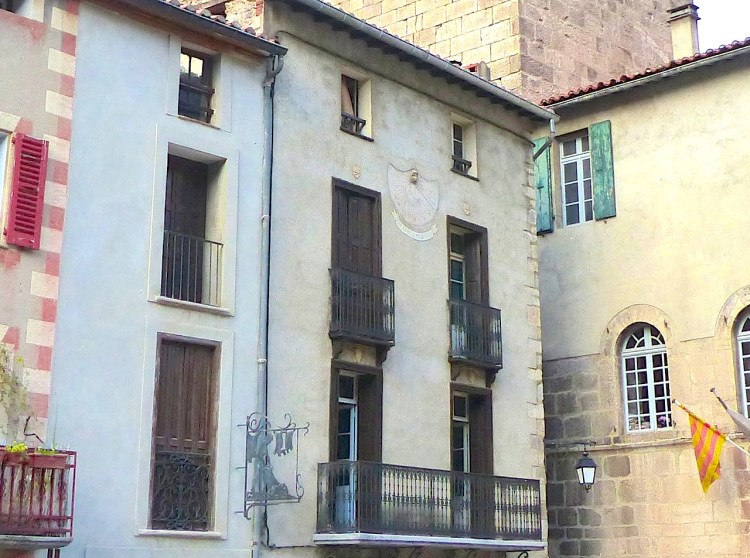
Double sundial, Villefranche-de-Conflent, Pyrénées-Orientales

The sundial above is high up on a house in the church square. It doesn’t exactly draw the eye, and would be very easy to miss. It’s on the house next to the Mairie (right, with the Catalan flag), below the small top windows.

Villefranche-de-Conflent - Sundial

Villefranche-de-Conflent - Sundial

TWO DIALS IN ONE

The main dial is etched and painted on cement, with roman numerals and showing hours, halves and quarters. The long gnomon is attached beneath a small sculpted head from which sun rays radiate – a simple representation of a solar deity. Above the head can be seen numbers, of which only 11 and 8 at the start, and 3 at the end can be made out with any certainty. Possibly, it is a date: the dial (which is not ancient) is otherwise undated and it is very hard to guess its age. I can find no explanation for the initials DS (top left, Gothic font) and ER (top right, normal font). 

The small dial-within-a-dial shows the hours only, with arabic numerals. The gnomon points straight down. I am unsure of its purpose as a supplementary dial on the same plane, but I hope to find out.

Villefranche-de-Conflent - Sundial

INSCRIPTION

The words “COM MES SOL FA MES BE ESCRIC” are Catalan and mean roughly “When it is sunny, I write (show the time) well”. This rather charming inscription was apparently added around 2000 by the village pastor.

Credit: for information, Michel Lalos, who has compiled a comprehensive illustrated record of the sundials of the Pyrénées-Orientales.