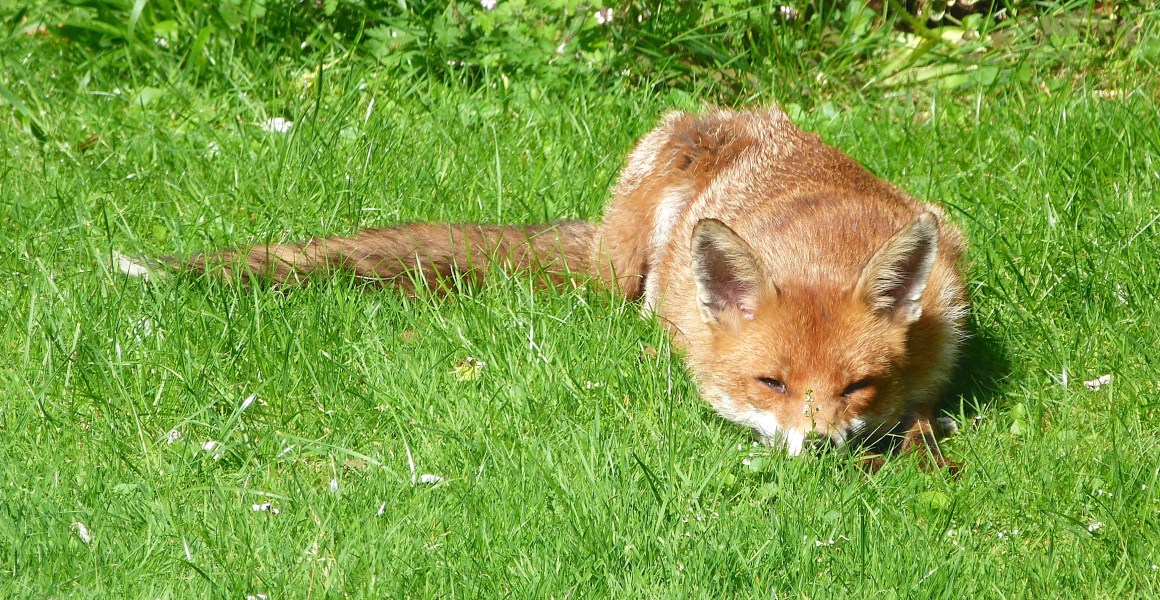
URBAN FOX ENJOYING JUNE SUNSHINE, WEST LONDON


This fox in our garden this morning was lazily lying down, occasionally sleepily moving around and even yawning. Always wary, possibly aware of the human near the kitchen window, he kept a beady eye on the house. Even so, he lay for some time with his eyes near-closed, soaking up the June sunshine. Here are some photos of the visitor. You’ll see he is far from the manky scavenger that is the usual urban fox.  He is well-groomed and with a good coat. These photos were taken through glass – I didn’t want to risk disturbing the fox by opening a window for a clearer shot.


City Fox, West London (Keith Salvesen)City Fox, West London (Keith Salvesen)City Fox, West London (Keith Salvesen)City Fox, West London (Keith Salvesen)City Fox, West London (Keith Salvesen)City Fox, West London (Keith Salvesen)City Fox, West London (Keith Salvesen)City Fox, West London (Keith Salvesen)

I’m terrible at keeping up with this blog. I’d take it down, but for the surprising number of people who turn up to view the contents – some themes are strangely popular. For which attention, much thanks. But I am going to try harder. I’m rejigging the format gradually, and will do some weeding, raking and transplanting. Let’s see how that goes…

PALE TUSSOCK MOTH, DORSET


Pale Tussock Moth, Dorset (Rolling Harbour)

Until a few days ago, I’m not sure I’d ever before seen a pale tussock moth Calliteara pudibunda that was on a wall inside our house. I took it outside and put it gently onto an old garden bench. 10 minutes later it was gone. As is so often the case I only had an iPhone with me at the time, so the photo above is a bit rough and ready. On the other hand, you get a good idea of the subtle and pretty colouring and marking of this moth – and as you see, it was intriguingly furry, with spotted legs.

P1150354.jpg

I flicked through a couple of slightly basic butterfly / moth books we have, but could find nothing like this creature. So I checked out the FB page of UK MOTHS to find a match. Sure enough, others had queried the ID of this species so I discovered the name easily enough. I don’t think it is particularly rare. There were also plenty of other fascinating and indeed extraordinary-looking moths that are apparently quite common in the UK. A FB page that’s well worth taking a look at.

The pale tussock is a moth of spring / early summer, and its appearance seems to be distinctive enough to avoid confusion with other moth species. The other feature, only deployed once I’d got it outside the house, are its feathery antennae (below).Pale Tussock Moth, Dorset (Rolling Harbour)

To make up for my rather poor photos, here is a really good one to make up for it, showing a pale tussock in all its glory…

Pale Tussock Moth (Kurt Kulac - wiki) Photo credit: Kurt Kulac / Wiki

CAIUS COLLEGE, CAMBRIDGE: 6 SUNDIALS ON THE GATE OF HONOUR


caius-college-cambridge-sundial-gate-of-honour1

Gonville and Caius College is one of the oldest colleges of Cambridge University. It was founded in 1348 by Edmund Gonville, who has suffered the cruel fate of rarely being mentioned nowadays; the college is almost invariably referred to simply as ‘Caius’, after John Caius, the man who re-founded the college in 1557 at a time when it had fallen on hard times.

The college has 3 fine gates that represent the stages of academic life: matriculation, with entrance through the Gate of Humility; undergraduate life, with regular passage through the Gate of Virtue during a student’s career; and finally graduation,with students passing through the Gate of Honour to the Senate House to receive their degrees.

The lower part of the Gate of Honourcaius-college-cambridge-sundial-gate-of-honour5

The middle section of the Gate of Honourcaius-college-cambridge-sundial-gate-of-honour4

The handsome modern sundial was installed in 1963 as part of the 400th anniversary celebration of the college’s re-foundation by Caius. There are in fact 6 vertical sundials, arranged in 3 pairs placed round the hexagonal tower. They were designed by an astronomer and fellow Dr Message, and the Junior Bursar Dr Powell. The bronze dial faces are painted with vitreous enamel. Of the original set of sundials dating from 1557, only traces remained.

caius-college-cambridge-sundial-gate-of-honour3

There is something very satisfying about this set of dials. The symmetry, the proportions, the materials and the design all seem to work in harmony. Cambridge colleges have many sundials between them, many original and ancient. Of the modern dials, the Caius Gate of Honour is adorned by, arguably, the finest.** 

caius-college-cambridge-sundial-gate-of-honour2

** The principal sundial of my own college is dignified but… somewhat undistinguished in comparison!

Photo credit: All photos Mrs RH during a recent academic festivity

For further reading, track down a copy of “Cambridge Sundials” by Alexis Brookes and Margaret Stanier (available from the British Sundial Society). It can also be found as a downloadable pdf. There is an equivalent book by Margaret Stanier covering Oxford