THE SUNDIALS AT LITLINGTON CHURCH, EAST SUSSEX (1)


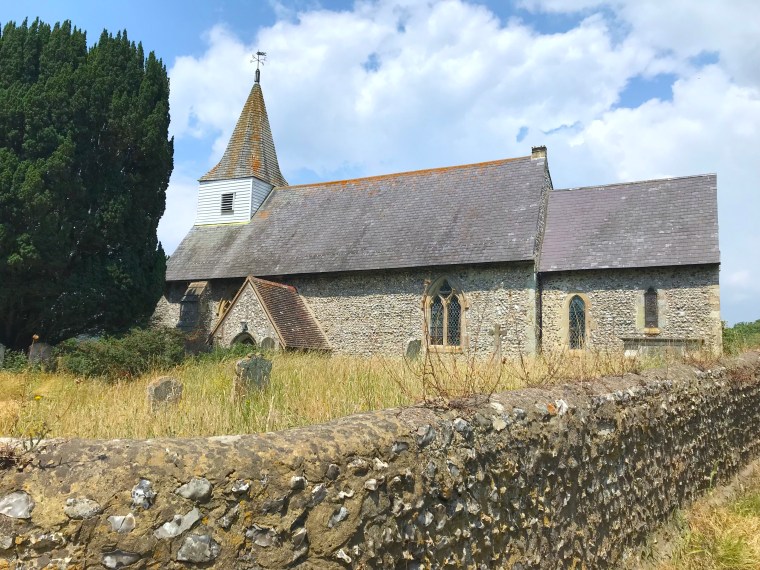
St Michael's Church, Litlington East Sussex (Keith Salvesen)The majority of churches have no integral sundial. Those that do are usually content with one; some may supplement that with a standing sundial in the churchyard. Very few have three sundials that are integral to the building itself and to its history. The small church of Litlington East Sussex is one such. It also has a large benchmark on the porch, and three superb bells dating from the early c15. The main sundial is easy to spot; the other two are far less visible. I spent sometime looking for them in vain, until the church warden took pity on me. But (*spoiler alert*) whoever would expect to find sundials low down on a north wall? They deserve a post in their own right, which will form part 2. They are so far undocumented as far as I can see, except locally.

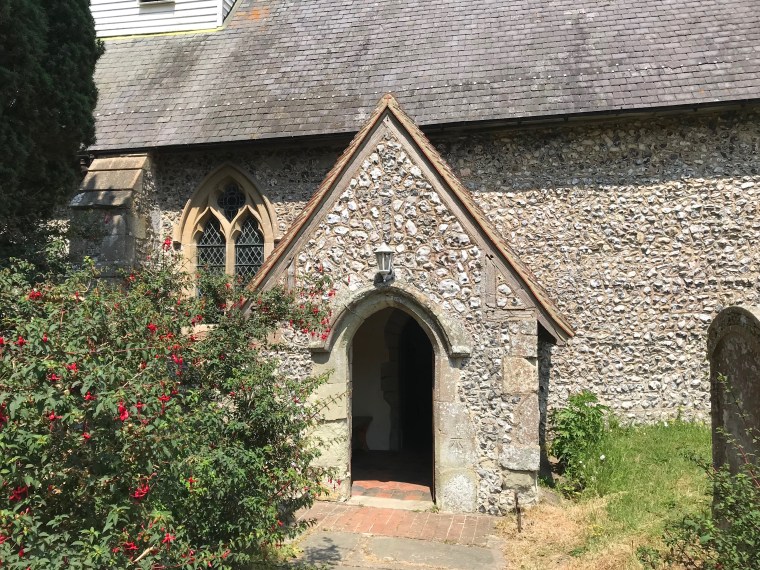
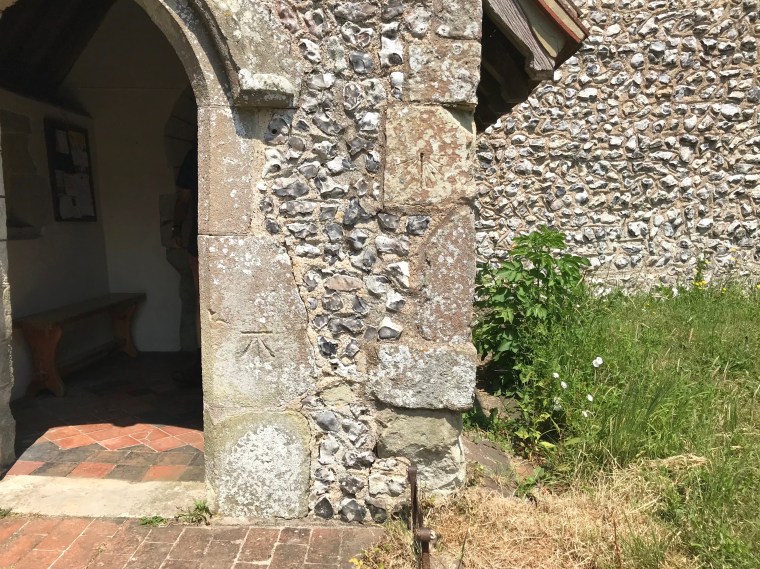
St Michael's Church - the porch. Litlington East Sussex (Keith Salvesen)The church dates from c1150, and was restored in the mid-c19. The porch is where the quest for the main sundial ends – the benchmark, too. 

St Michael's Church - sundial & benchmark. Litlington East Sussex (Keith Salvesen)
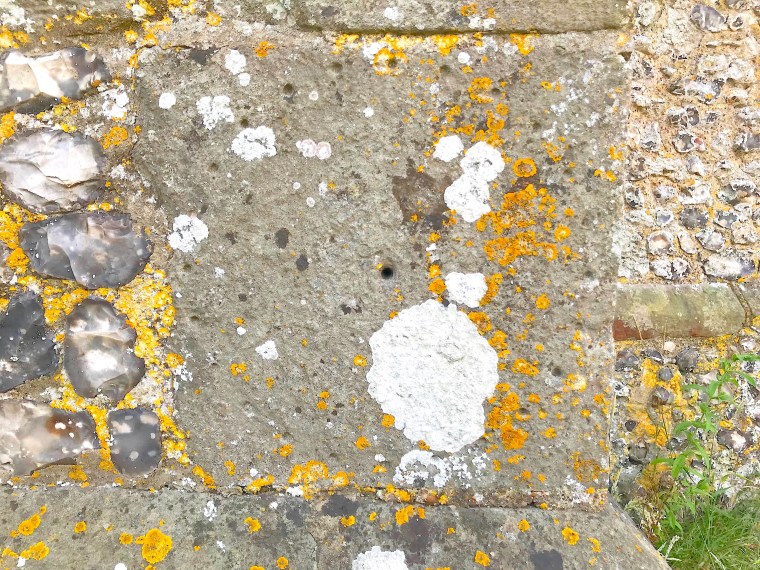
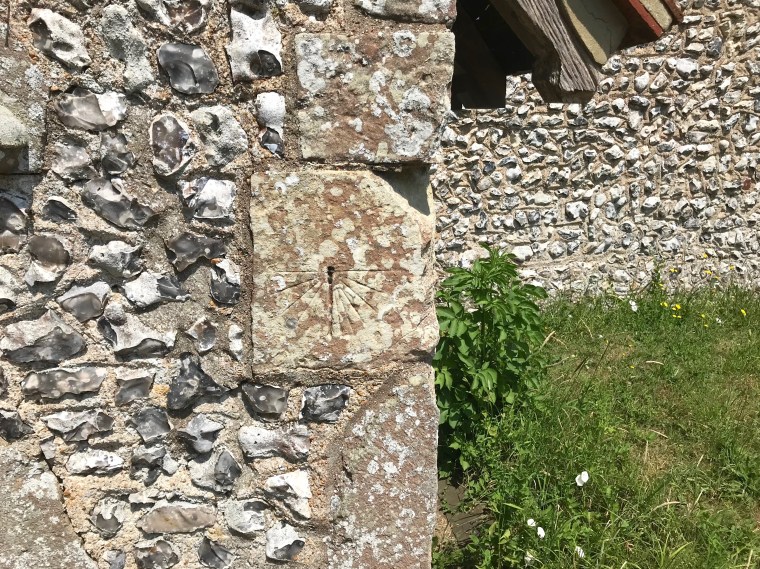
A close inspection shows just how unusual this scratch dial is – quite possibly unique. The only full account of it that I have found appears in an article by W. Oliver published in SCM* Volume 12 1938  Page 529The link is given below.
St Michael's Church, Litlington East Sussex (Keith Salvesen)

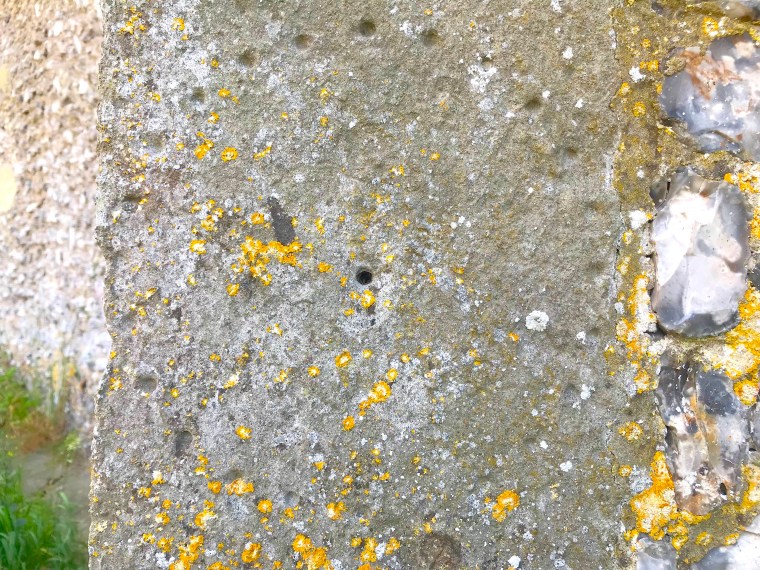
There are 3 features that immediately stand out: the deep ‘furrow’ at 12 noon; the confusing style / pointer holes; and in particular the carefully graduated hour markings. 

An improvised biro ‘style’ indicates the correct timeSt Michael's Church, Litlington East Sussex (Keith Salvesen)

A REMARKABLE DIAL

W. Oliver makes several points in his article, which distilled come to this:

  • This is a scratch dial typical of Saxon times and the middle ages, incised on the building stones
  • The design (for the period) is “most exceptional, if not unique” among the 1400 recorded church scratch dials
  • Other dials have equally spaced hour-lines that cannot measure time accurately, and certainly not year-long (though pointer adjustments could be made to compensate) 
  • These were primarily intended to indicate the 5 Canonical hours for prayer, not time
  • Extra lines were sometimes added, as time measurement became more sophisticated
  • At Litlington, exceptionally, the hour-line spacing is ‘scientific’ to enable accuracy
  • The lines are carefully graduated down to and up from 12 noon
  • This scientific approach is very much as seen on modern vertical sundials
  • The usual hole for a style / pointer is supplemented by the deeper groove at noon
  • This suggests there was at some stage a slanting gnomon, as found on modern wall dials
  • This could have been set to the latitude of Litlington to ensure year-round accuracy
  • The Litlington scratch dial may in fact be the only one able to tell the time properly

Church Sundial at Litlington By W. Oliver  http://www.massdials.org.uk/texts/scm12.htm

Do the 3 holes support the theory of an added gnomon fixed below the original style hole?St Michael's Church, Litlington East Sussex (Keith Salvesen)

DATING THE DIAL

W. Oliver does not give a date for the dial, other than ‘Middle Ages’ (it’s clearly not as old as Saxon). In a website called https://www.bestofengland.com the entry for this church states “Outside there is still a 13th century sundial on the porch”. This dating seems to have caught on and appears in e.g. Tripadvisor descriptions.

The local website http://www.litlington.info/st-michael-the-archangel-church-litlington says “Outside, on the porch, is a 15th century scientific sundial…” Given the sophistication of the Litlington dial, the first date seems clearly wrong and the second must be the preferred date. It also fits in with date of the installation of the earliest bell – perhaps a time of general improvements to the church. Even so, in the light of W. Oliver’s analysis, the dial shows an extraordinary understanding of the principles of recording time accurately that is apparently absent in the 1399 other instances of scratch dials in the country. The British Sundial Society has a short entry (see below) for this dial (and none for the other two at the ‘back’ of this church, mentioned earlier), including a reference to a polar gnomon. No mention of a possible date, but I take ‘transitional’ to mean between the era of marking the Canonical Hours and the gradual move to a 12 / 24 hour clock as the standard for time-telling.

BRITISH SUNDIAL SOCIETY

The brief entry states “The dial can be seen to the right of the porch. All hour lines 6am – 6pm, but no numbers or any trace that there ever were any. Lines correctly delineated for a polar gnomon. No trace of old lines, so possibly not a re-cut mass dial. 310 diam. semicircle. Transitional dial? Ref. C Daniel, Sundials, Shire Album 176,1986, p5 Location 50°47’50″N, 0°9’34″E;  National Grid: TQ 523 020″

The illustration to W. Oliver’s article

Any comments about this remarkable dial would be welcome.

Research as specified / linked. * = Sussex County Magazine. The Litlington website entry is as recorded by the Eastbourne Church Recording Group between 2007/2009. All photos Keith Salvesen / Rolling Harbour except as indicated

SMALL MAGPIE MOTH, DORSET


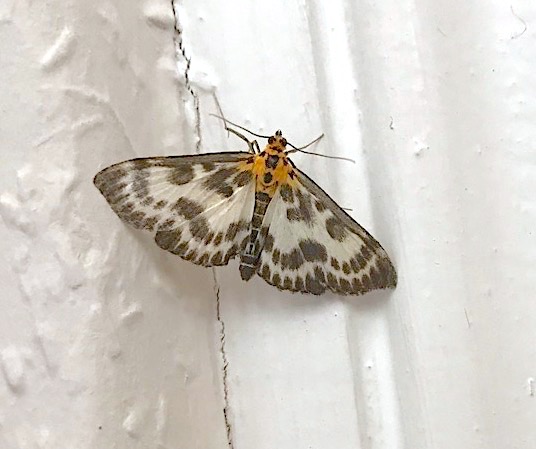
I posted about the MAGPIE MOTH quite a while ago. Now I’ve come across its junior cousin, the small magpie moth. This one was in a hard to photograph corner (especially with an iPhone), and the images are neither good nor varied (it stayed completely still). But it’s another species to add to the list. Unlike the large magpie, the small variety has no yellow band across the wings,

Small Magpie Moth, Dorset Small Magpie Moth, Dorset Small Magpie Moth, Dorset

MARIAKIRKEN, BERGEN: A FINE DOORWAY


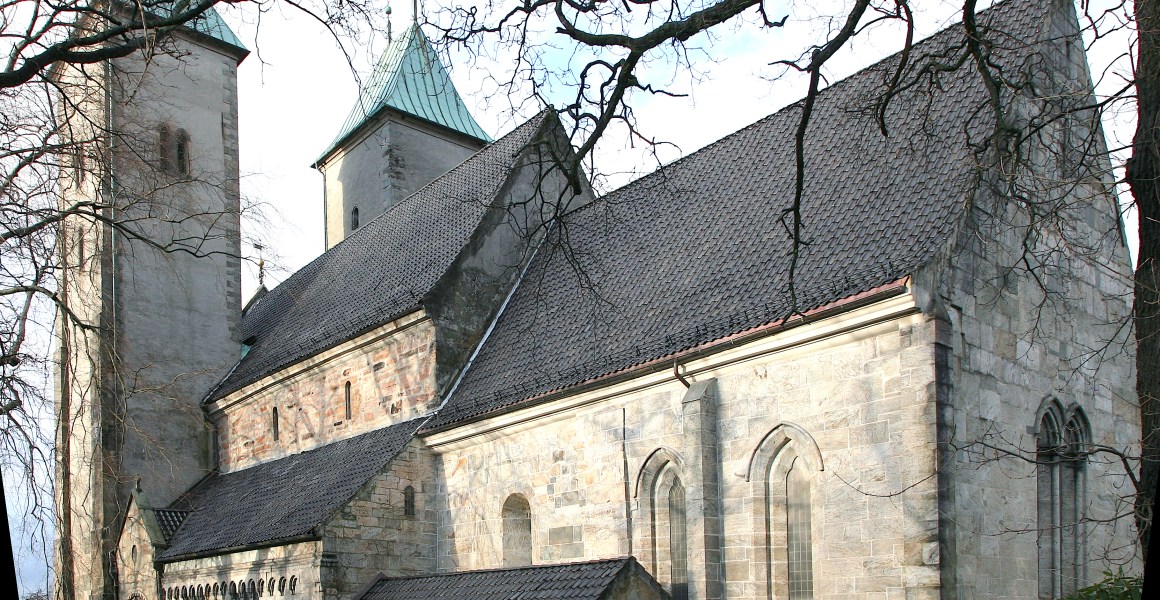
Mariakirken is an historic parish church in the central Bryggen area of Bergen, Norway. The church dates from the c12, and is said to be the oldest in Bergen. It is certainly the last remaining church from that early period. However, over the centuries the church has had to be repaired or reconstructed a number of times, not least due to fires – a problem arising in part from the close-built wooden houses and warehouses (as with the great fire of London). The last restoration was completed 4 years ago.

Marienkirken Bergen (Nina Aldin Thune / Wiki)

There was a service in progress when we walked up to the church from the harbour on a rather grey day. We had noticed people in Bunad (traditional costume) earlier, perhaps on their way to this church. So we headed for the splendid romanesque doorway, reminiscent of Norman architecture elsewhere in Europe.

The church is also known locally as ‘the German Church’. In the middle ages Bergen had a significant German population consisting mainly of the traders and merchants. Their wealth helped the Church to prosper. The strong connection continued until the late c19.

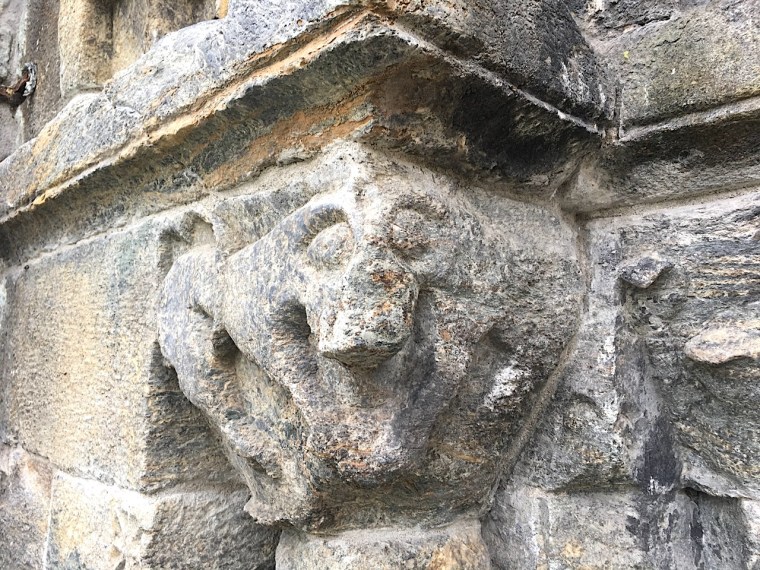
The details of the porch are most enjoyable, with the toothed arch, twist columns and arch, and its depth seeming to invite one inside. The carvings on the capitals are interesting, especially the creatures on either side – I have seen very similar early medieval ones in southwest France.  Next time we go to Bergen, we must investigate the interior…

General Church photo, Nina Aldin Thune / Wiki (my own was hopeless, as it turned out); rest © Keith Salvesen 

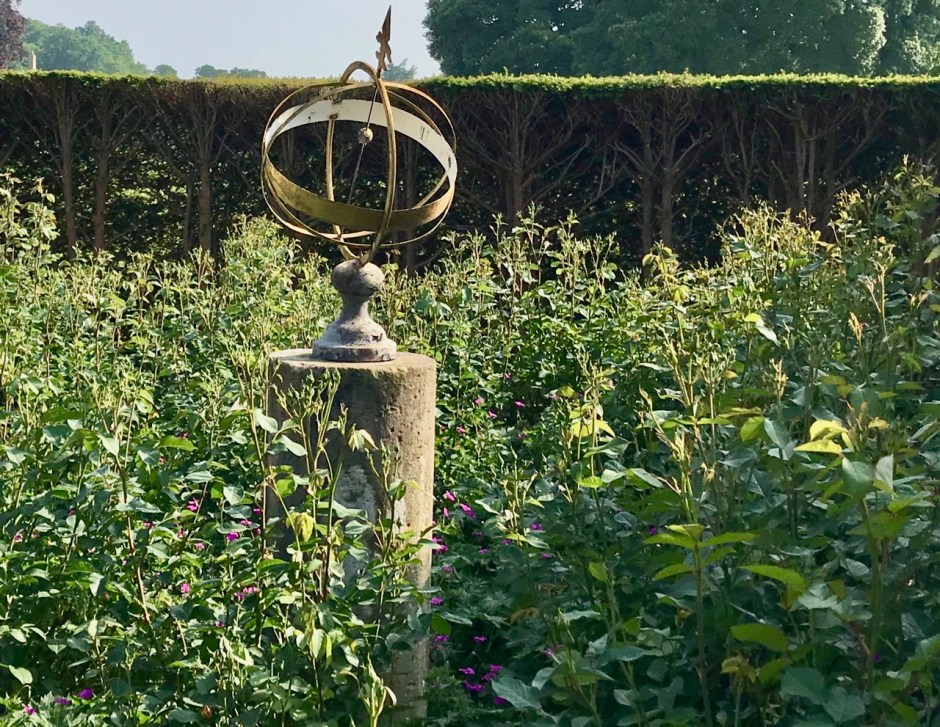
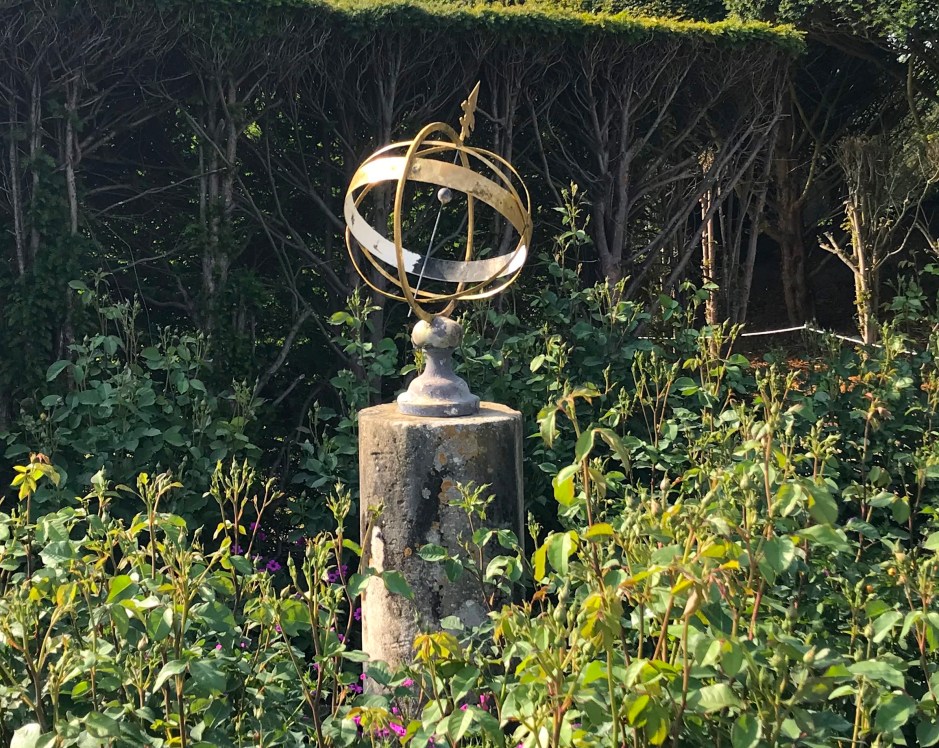
ARMILLARY SPHERE SUNDIAL: KINGSTON LACY, DORSET


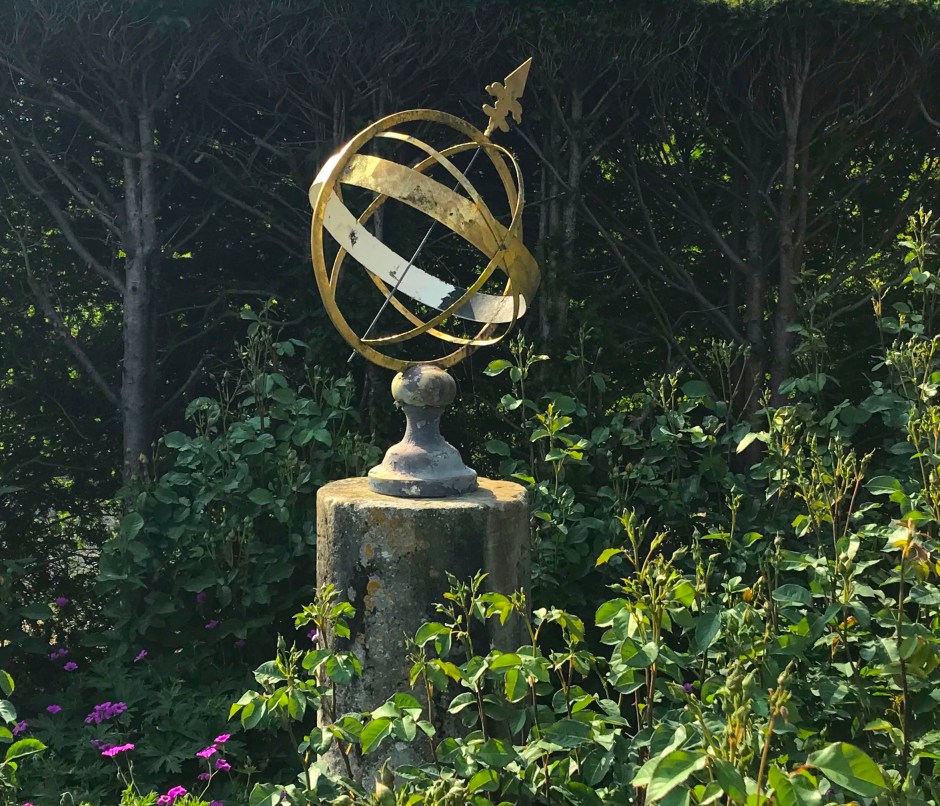
ARMILLARY SPHERE SUNDIAL: KINGSTON LACY, DORSET (Keith Salvesen)

This enjoyable armillary sphere at Kingston Lacy stands proudly on a tall stone baluster in the middle of a rose garden. I wanted to get close to it to look for markings, few of which were visible at a distance. However the lush spring growth deterred closer investigation, and I preferred to leave it inspected. It is not included in Historic England’s detailed descriptions of the house and garden. A photograph found online suggests that the sundial was at one time located elsewhere in the garden, near a wall. I need to try a bit harder to find a date for it.

ARMILLARY SPHERE SUNDIAL: KINGSTON LACY, DORSET (Keith Salvesen) ARMILLARY SPHERE SUNDIAL: KINGSTON LACY, DORSET (Keith Salvesen) ARMILLARY SPHERE SUNDIAL: KINGSTON LACY, DORSET (Keith Salvesen) ARMILLARY SPHERE SUNDIAL: KINGSTON LACY, DORSET (Keith Salvesen) ARMILLARY SPHERE SUNDIAL: KINGSTON LACY, DORSET (Keith Salvesen)

All photos: Keith Salvesen Photography

BOMBUS HYPNORUM: A TREE / GARDEN (& HOUSE) BEE


I watched this small bee as it circled round the flower, busily filling its already bulging bright yellow saddlebags. We are fond of these little bees, which were introduced to the UK (or perhaps simply spread here) quite recently and have made themselves at home. They are one of two bee species that have chosen to live inside our house. 

The location varies from year to year, but for about 3 months a year over the last few years there has been gentle bee-chatter going on in the roof-space above our bedroom, or in an old wall cavity between 2 rooms.

Bombus Hypnorum - The Tree of Garden Bee (Keith Salvesen)

This year the tree bees decamped to the roof-space above the kitchen; and a splinter colony has recently set up a buzzing plant-produce stall in a cavity above the front porch, no doubt to the surprise of the bats that hang out there.
Bombus Hypnorum - The Tree of Garden Bee (Keith Salvesen)You may have noticed that the bee featured here is carrying a tiny passenger, a mite, that you can see in some of the images (eg the header image). There’s a small story about these photos. I own ‘beloved camera’, ‘unreliable camera’, ‘snappy camera’ and an iPhone. **

Bombus Hypnorum - The Tree of Garden Bee (Keith Salvesen)

When I first saw this little bee, I had ‘unreliable’ with me (‘beloved’ being 125 miles away). It is a martyr to light sensitivity, with an annoying ‘satirical’ take on focus. Reader, I rattled off 20 shots. Then I deleted every one of them. Quickly throwing the camera behind a wall in disgrace, I reached for my phone in desperation to catch the bee at work in the sunshine. Here are the results, with a level of clarity that only ‘beloved camera’ could have matched.

Bombus Hypnorum - The Tree of Garden Bee (Keith Salvesen)

** There was ‘hated camera’ too, a DSLR that I never mastered and eventually sold back to the place I bought it for a fraction of the original cost. They saw me coming…

All photos © Keith Salvesen Photography

OXFORD COMMAS: GRAMMATICAL LEPIDOPTERA


Comma Butterfly (Keith Salvesen)

This is a Comma butterfly that happens to have been photographed in Oxford. There are plenty about right now – I’ve been seeing them in London, coastal Sussex and Dorset. This one in Oxford was enjoying Nepeta (catmint), and providing a lazy excuse to reference the seemingly interminable ‘Oxford Comma’ grammar debate – the question whether, in a list of items, a comma is mandatory before the eventual ‘and’. See below (if you can be bothered in all this hot weather / while the World Cup is on).

Comma Butterfly (Keith Salvesen) Comma Butterfly (Keith Salvesen) Comma Butterfly (Keith Salvesen)

“I love my parents, Jesus Christ and Lady Gaga”. Does this make any kind of sense? No. Exactly. You are not the progeny of Christ and a self-enobled and cannily bonkers popular singer. You need a comma before the ‘and’ for the sentence to make sense. Only then are you clearly loving each of those specified independently. I rest my case.

URBAN FOX ENJOYING JUNE SUNSHINE, WEST LONDON


This fox in our garden this morning was lazily lying down, occasionally sleepily moving around and even yawning. Always wary, possibly aware of the human near the kitchen window, he kept a beady eye on the house. Even so, he lay for some time with his eyes near-closed, soaking up the June sunshine. Here are some photos of the visitor. You’ll see he is far from the manky scavenger that is the usual urban fox.  He is well-groomed and with a good coat. These photos were taken through glass – I didn’t want to risk disturbing the fox by opening a window for a clearer shot.

City Fox, West London (Keith Salvesen)City Fox, West London (Keith Salvesen)City Fox, West London (Keith Salvesen)City Fox, West London (Keith Salvesen)City Fox, West London (Keith Salvesen)City Fox, West London (Keith Salvesen)City Fox, West London (Keith Salvesen)City Fox, West London (Keith Salvesen)

I’m terrible at keeping up with this blog. I’d take it down, but for the surprising number of people who turn up to view the contents – some themes are strangely popular. For which attention, much thanks. But I am going to try harder. I’m rejigging the format gradually, and will do some weeding, raking and transplanting. Let’s see how that goes…

A STAINED GLASS SUNDIAL AT TOLLER PORCORUM, DORSET


Toller Porcorum is an archetypal Dorset village, right down to a latinate name redolent of medieval swine-herding (cf Ryme Intrinseca, Kington Magna etc). The fine Church of St Peter and St Andrew lies at the heart of the village, and is also very ‘Dorset’. 

Toller Porcorum Church, Dorset (Nigel Walden / Geograph)

While I was fishing on the nearby River Frome a couple of weeks ago, Mrs RH visited some churches in the area, including this one. Inside, she noticed an unusual modern ‘glass sundial’ set in a stained glass window, a marker of the hours and the millennium.  

Toller Porcorum Church, Dorset - Stained Glass Sundial

Knowing that sundials are one of the features on this blog, she took a few photographs with her phone. They have come out very well. 

Toller Porcorum Church, Dorset - Stained Glass Sundial

In the close-up above, you can just make out the shadow of the gnomon at approx 12.40 (midday being at the bottom). On the outside the gnomon, in the right-hand window (below), is elegantly simple and  unobtrusive. The close-up shows it more clearly. But of course the effect is meant to be seen from the inside, if only to time the length of the sermon.

Toller Porcorum Church, Dorset - Stained Glass Sundial

Toller Porcorum Church, Dorset - Stained Glass Sundial

Lordy, but I am negligent of this site. Thanks you, kind people who still come to look at stuff  here even though (I am ashamed to note) my last post was in November 2017. I’m going to try to get back on track with this side-project… there’s quite a backlog of material!

MILTON ABBEY, DORSET


Milton Abbey, Dorset

Milton Abbey, more properly called ‘The Abbey Church of St Mary, St Sansom and St Bradwalader*’, is a former Benedictine monastery founded in c10. The present building dates from the c14 and c15. The Abbey, with a post-reformation country house attached where the monastic buildings used to be, is now a school. 

Milton Abbey, Dorset - Abbey Church of St Mary, St Sansom and St BradwaladerThe Church building consists of the tower, transepts and choir. The nave is entirely absent, not as the result of the reformation’s destructive zeal (though that may account for the absence of statues in the empty interior niches). In fact, the nave was never built. The blank arch on the ‘front’ side (below) indictes how huge the nave – and the completed edifice –  would have been.

Milton Abbey, Dorset

The country house / school buildings are to the left side of the Abbey. This isn’t the place to detail the comings and goings of the various families who lived there, but it’s all on Wiki and also in an exhaustive entry in the Dorset ‘Pevsner’ – or in more technical detail HERE

We enjoyed a c15 pun high on a wall inside the Church. The date shown on the device looks at first sight to be 1618, but is in fact 1514. Medieval numbering was not formed in quite the way we are familiar with now. The W stands for Abbot William of Middleton (the original town name, shortened to Milton), with his rebus, a mill on top of a tun. Milton Abbey, Dorset (detail)Close to the Church, there is a small stone circle about which I became quite excited. Sadly, a complete lack of mention of this circle in any historical context suggests that it is a modern imposter, perhaps related to a school project. But it’s pretty convincing!

Stone Circle at Milton Abbey, Dorset (Keith Salvesen)

*Me neither. And online research doesn’t disclose much about St Bradwalader. Or indeed anything at all.

All photos: Keith Salvesen

CARL LINNAEUS: CLASSIFYING NATURAL HISTORY (1)


Carl Linneaus Portrait (OS)

‘THE FIRST EDITION’

Carl Linnaeus (1707 – 1778) is arguably the most renowned Swedish naturalist. Maybe unarguably. Before the age of 30, his orderly and rigorous scientific methodology had created a new standard system for the classification of the natural world. As initial challenges to his great work fell to one side, so he bestrode his present and the future natural world as a great innovator. His system has stood the test of time to this day – and in Latin, too. As the saying goes, “Deus Creavit; Linnaeus Disposuit“: God created, Linnaeus organised. In fact, Linnaeus himself was (rather vainly?) the originator of the adage…

ANIMAL, VEGETABLE & MINERAL

Linnaeus first had to define the broad categories in order to organise them into their component parts. He chose regnum animale, regnum vegetabile and regnum lapideum – the animal, vegetable (plant) and mineral kingdoms. Here are some examples, photographed in the climate-controlled ‘treasures room’ at the Linnean Society, London during a viewing with the Librarian.

The first column of the first substantive page of the first edition of Systema Naturae (1735). This is the start of it all – the ‘man-like’ creatures Man [classed as a quadruped], apes and… 3-toed sloths (Bradypus), later to be moved to a more comfortable place. After that come creatures large and small, wild and domesticated, including lions, bears, cats, weasels, and moles. Canis included not only the dog, wolf, and fox but also… the squillachi. The last one is a mystery – a quick online search reveals only a footballer of that name.

Systema Naturae 1735 - quadrupeds (© KS / Rolling Harbour)

At the bottom of the first column, horses, hippos, elephants and varieties of pig are classified together; followed by varieties of camel, deer, goat, sheep and cattle.

Systema Naturae 1735 - quadrupeds 2 (© KS / Rolling Harbour)

Linnaeus’s achievements in ‘organising’ were twofold. First, he grouped creatures, plants and minerals into similar species, using his prodigious knowledge to arrange the groups into defined hierarchies (and as it was to turn out, not invariably correctly). Secondly, he adapted and refined an existing but somewhat random scheme into his structured binomial system, attaching two names to each creature, plant or mineral. The first name was a general categorisation (‘genera’); the second was more specific (‘species’). Consistency was achieved for the first time. Linnaeus was indeed the ‘father of taxonomy’ as we still know it today. He probably called himself that as well.

Here are some of the birds – grackles, doves, gulls and so on down the list. The latin names will be very familiar to birders, since they are still used today. The birds are followed by columns for amphibians, fishes, insects and sea creatures such as jellyfish, conchs and urchins.

Systema Naturae 1735 - birds (© KS / Rolling Harbour)

Entries in the minerals section, with schist, marble and quartz perhaps the most easily identifiable.Systema Naturae 1735 - minerals (© KS / Rolling Harbour)

PARADOXA

On the right of the bird column shown above is a hint of a ‘random’ category. My detailed photo of it didn’t work, so I include a facsimile copy is below. These were creatures that were known of, or believed possibly to exist but for which there was perhaps scant scientific evidence. The hydra. The monocerous. The pelican. The satyr. The borometz (half-sheep, half-plant), phoenix and dragon. And so on. Bearing in mind the date of this work, it is perhaps not surprising that Linnaeus kept his mind and his options open about such creatures. You can read about all these Paradoxa in an excellent Wiki article HERE

Systema Naturae 1735 - paradoxa (© KS / Rolling Harbour)

SYSTEMA NATURAE (1735)

The title page of the first edition of Systema Naturae (1735). This was the first page we were shown, after the book had been laid reverently on a special cushion by the Librarian. I have to admit to a jolt of excitement, both then and indeed several times more during our visit.

Systema Naturae 1735 - title page (© KS / Rolling Harbour)

Published in 1735 when Linnaeus was a mere 28, Systema Naturae was both revolutionary and evolutionary.The full title of the work spelled out the breadth of the enterprise: “System of nature through the three kingdoms of nature, according to classes, orders, genera and species, with characters, differences, synonyms, places”.  At least 12 further editions were published during his lifetime. Each was expanded as more scientific data was gathered; from 11 pages in the 1st edition to more than 2000 in the 12th, published about 30 years later.  Corrections were also made. For example, the initial assignment of whales to fishes, based on knowledge at the time, was later corrected to include them with mammals.

The Taxonomic Hierarchy (+ Setophaga pityophila)Taxonomic Hierarchy ' Olive-capped Warbler (© Tom Sheley / Keith Salvesen)

IN PART 2: THE COLLECTIONS OF LINNAEUS

The extraordinary manuscript, specimen and library collection of Linnaeus is preserved in this wonderful treasure store. I took this photograph at the end of the viewing. By this stage we had examined a selection of the sample cases – note the open drawers and cases on the table. Also, note the special cushion for the precious manuscripts.
Linnaeus Collection, Linnean Society (© KS / Rolling Harbour)

All photographs © Keith Salvesen; portrait and facsimile scan of Paradoxa, O/S; Olive-capped Warbler (as annotated by me), Tom Sheley; magpie pickings from a wide variety of sources inc. Linnean Society, Smithsonian, Encyclopaedia Britannica online – and not excl. Wiki!