ABBEY OF SAINT-MARTIN-DU-CANIGOU (1)


Abbey of st-martin-du-canigou-a-9

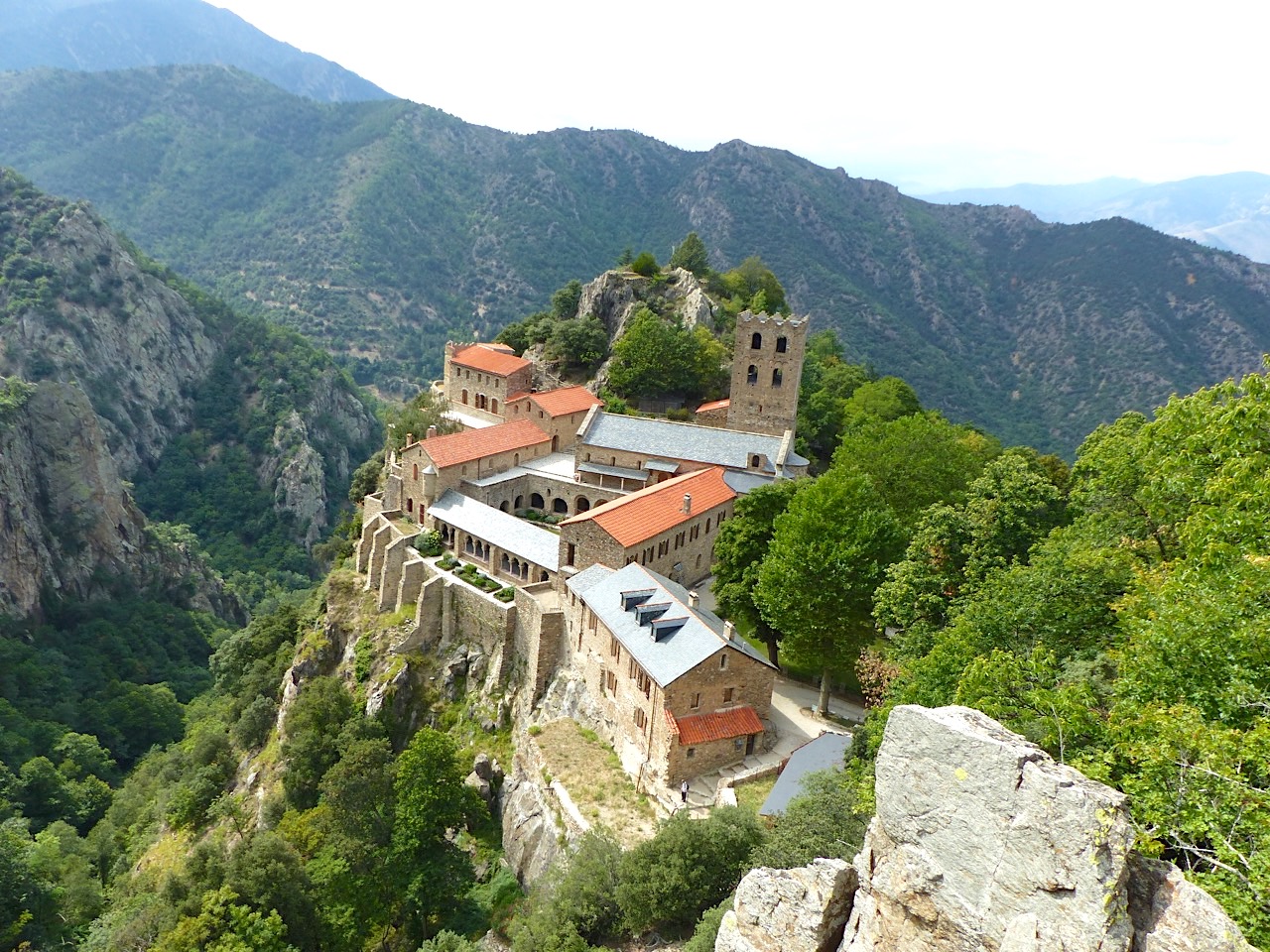
The Pyrénées-Orientales department is rich in early medieval religious foundations. One of the most striking is the abbey of Saint-Martin-du-Canigou, a Benedictine monastery founded in 1009 on the flanks of The Canigou. This high mountain (2,784 m /9137 ft) – once thought to be the highest in the Pyrenees – is of particular symbolic significance in this Catalan region, one that has changed ownership and allegiances many times over the centuries. Even now the Catalan flag predominates in public places. 

Abbey of St Martin du Canigou

The Abbey is pleasingly inaccessible. Leaving aside a precipitous donkey track down a cliff, there is an easier track that leads up from the little village of Casteil. On certain days, at certain times, this can be negotiated by going in a small trailer drawn by a kind of skinny quadbike. Or else, it’s shanks’s pony. The steep walk is said to take 30 – 50 minutes. You’d have to be fit to reach the abbey in less than half an hour. We took 45 minutes, overtaken at intervals by serious walkers with kit to match. And gratifyingly, we overtook several puffing, wheezing and (frankly) sweaty pilgrims in our turn.

A view, as if from the upper slopes of Canigou (Google)St Martin du Canigou Map smdc-2-jpg

Much of the trek is through woodland, with encounters with red squirrels, nuthatches, black redstarts and a surprising variety of  butterfly species. The vertical rise from the village to the Abbey is well over 1000 feet, and the mountain air is sweet and clear. Apart from a small chapel on the way and the visitor centre, there are no buildings apart from the Abbey. Those with the energy left can climb  higher to a promontory overlooking the Abbey, from which the postcard and guidebook view can be replicated (header image). However there is the added advantage of being able to take zoom photos.

The gorge on the left side gives a good idea of how precariously the Abbey is perched on the cliff topst-martin-du-canigou-a-7-copyst-martin-du-canigou-a-5

Over the centuries, the Abbey has suffered earthquake damage, secularisation in the c18, and consequent abandonment by the monks. Thereafter, it fell into disrepair, then ruin. Most of the contents were dispersed. The buildings were then treated as a quarry. The wonderful and important capitals of the cloister were looted, as were the remaining sculptures. 
st-martin-du-canigou-a-2

And so the ruins were left for well over 100 years until, in 1902, a local Bishop of Catalan origin began the massive task of restoration. Thirty years later, the work was complete. The lower church – basically the crypt – was found to be largely undamaged, and is substantially as it was in the c11. Much of the upper church and the cloister was able to be reconstructed. The rest of the monastery buildings are early c20.

st-martin-du-canigou-a-3

The Abbey is currently occupied by the Catholic Community of the Beatitudes. This is a remarkable charismatic order, not least because both consecrated men and women can be members, as can priests. Furthermore, it is inclusive of unconsecrated people – even families – who share the broad beliefs and aims of the community and their missionary activities in parishes and hospitals. We were shown around by a remarkably spritely and down-to-earth young nun (at one stage she high-fived me!).

The cloister deserves separate consideration, not least because of the wonderful capitals, some of which were, amazingly, recovered as the result of a diligent search for dispersed original material during the restoration.

st-martin-du-canigou-a-8If you want to find out more about this remarkable place, it has its own website with plenty of information HERE

‘UNEXPECTED TIMES’: A SUNDIAL ON THE PONTE VECCHIO


sundial-ponte-vecchio-florence-4

Florence in January.  -8°C at night, zero during the day – but sunny enough in the middle of the day to be able to have coffee or even lunch outside. Apart from the Uffizi, no queues for anywhere. Most significant places on the tourist trail almost to oneself. Despite the cold, there is no frost: the air is so dry that the pavements, piazzas and even the cars are quite clear of frozen white crystals. By the river I caught the electric flash of a male kingfisher flying up from the water to an overhanging bush, his hunting perch. I watched him as he scanned the water below, occasionally diving down and returning to the same branch. Twice, I could see the glint of a tiny fish in his beak. 

sundial-ponte-vecchio-florence-5

Since I was 17 I have been lucky enough to visit Florence quite often, not least because Mrs RH regularly goes there on business, and I am a keen ‘trailing spouse’. Over the years I don’t know how often I have crossed the Ponte Vecchio – or even simply walked to the mid-point to admire the views up and down river from the open areas between the pricey shops. This time I was walking the length of the Vasari corridor that connects the Palazzo Vecchio to the Palazzo Pitti on the other side of the Arno. A section runs straight over the bridge and then passes across the facade of Santa Felicita, into which the Medici family could sneak from the corridor to a large private balcony for spiritual refreshment. Passing the middle of the west side of the bridge, in the ‘tourist photo opp’ gap where Cellini’s bust adds to the photogenic view, I have never before looked upwards.

sundial-ponte-vecchio-florence-2

Here, on the roof of a shop, is an ancient sundial, supported by a white marble pillar. An eroded and almost illegible engraving below the pillar records that in 1333, floods caused the bridge to collapse and that “twelve years later, as pleased the Commune, it was rebuilt with this ornamentation”. The sundial itself, with its columnar divisions reminiscent of a rose window, marks the CANONICAL HOURS. The gnomon’s shadow indicates the hour of the day. If the sundial is the ‘ornamentation’ to which the inscription refers, then it is around 650 years old.

If you look closely at the pillar, you’ll see, halfway up the south face of the hexagonal column, a lizardsundial-ponte-vecchio-florence-1

Seeing the sundial for the first time ever, yet in such a familiar place was a reminder that Florence is a city that demands great attention as one walks through the streets. Many buildings, even unassuming ones, have fine adornments high up that will catch the eye… but only if you are looking out for them. 

sundial-ponte-vecchio-florence-7

LIBRARY TREASURES FROM CAMBRIDGE


treasures-from-the-university-library-cambridge-4treasures-from-the-university-library-cambridge-2treasures-from-the-university-library-cambridge-3treasures-from-the-university-library-cambridge-4

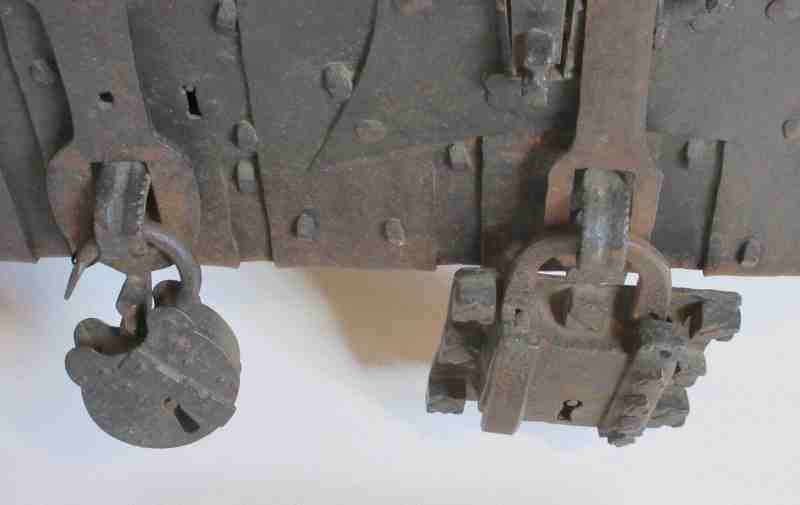
During a recent stay in Cambridge for an academic hooley, Mrs RH visited the University Library. She came across this wonderful multi-locked portable chest (above), and the University’s copy of the Gutenberg Bible. There are only about 40 complete Bibles extant in the world, plus some that are incomplete. I am lucky enough to have seen 3 of them, all in the US (Bienecke Library, Yale; Morgan Library NYC and New York Public Library). However to my retrospective shame, I never once in 3 years of golden opportunities took the trouble to go to the University Library in Cambridge (probably all of 15 minutes walk from my College). Seeing the photograph below made me ponder on youthful time that could (un)arguably have been better spent…

treasures-from-the-university-library-cambridge-5treasures-from-the-university-library-cambridge-6

A PUZZLING SUNDIAL IN THE PYRÉNÉES-ORIENTALES


VILLEFRANCHE-DE-CONFLENT is a small medieval walled town in Catalan country. It is watched over by Fort Liberia, one of VAUBAN‘s massive defensive constructions in this historically strategic area. The town is charming, and additionally famous for being the start of the ‘Train Jaune’, a picturesque narrow-gauge railway that climbs high into the Pyrénées. The amazing altitude rise is from 1250 ft at Villefranche to 5000 ft at the track’s summit just above the village of Mont Louis (which has its own Vauban fort) 

Double sundial, Villefranche-de-Conflent, Pyrénées-Orientales

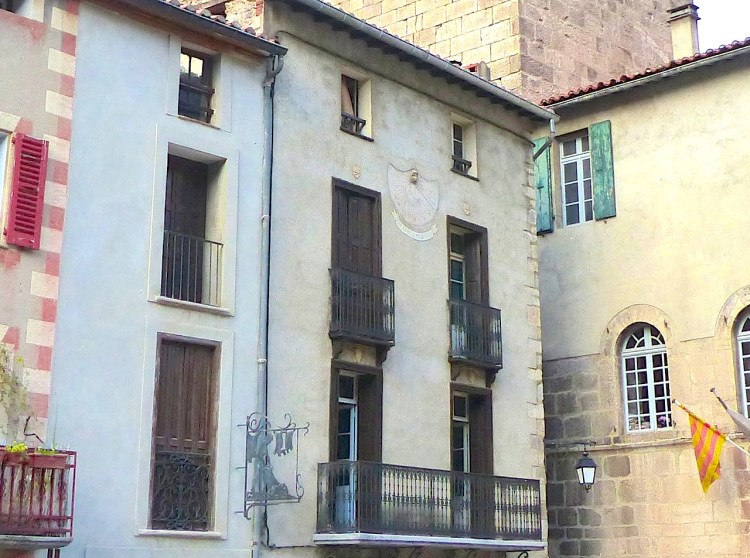
The sundial above is high up on a house in the church square. It doesn’t exactly draw the eye, and would be very easy to miss. It’s on the house next to the Mairie (right, with the Catalan flag), below the small top windows.

Villefranche-de-Conflent - Sundial

Villefranche-de-Conflent - Sundial

TWO DIALS IN ONE

The main dial is etched and painted on cement, with roman numerals and showing hours, halves and quarters. The long gnomon is attached beneath a small sculpted head from which sun rays radiate – a simple representation of a solar deity. Above the head can be seen numbers, of which only 11 and 8 at the start, and 3 at the end can be made out with any certainty. Possibly, it is a date: the dial (which is not ancient) is otherwise undated and it is very hard to guess its age. I can find no explanation for the initials DS (top left, Gothic font) and ER (top right, normal font). 

The small dial-within-a-dial shows the hours only, with arabic numerals. The gnomon points straight down. I am unsure of its purpose as a supplementary dial on the same plane, but I hope to find out.

Villefranche-de-Conflent - Sundial

INSCRIPTION

The words “COM MES SOL FA MES BE ESCRIC” are Catalan and mean roughly “When it is sunny, I write (show the time) well”. This rather charming inscription was apparently added around 2000 by the village pastor.

Credit: for information, Michel Lalos, who has compiled a comprehensive illustrated record of the sundials of the Pyrénées-Orientales.

CAIUS COLLEGE, CAMBRIDGE: 6 SUNDIALS ON THE GATE OF HONOUR


caius-college-cambridge-sundial-gate-of-honour1

Gonville and Caius College is one of the oldest colleges of Cambridge University. It was founded in 1348 by Edmund Gonville, who has suffered the cruel fate of rarely being mentioned nowadays; the college is almost invariably referred to simply as ‘Caius’, after John Caius, the man who re-founded the college in 1557 at a time when it had fallen on hard times.

The college has 3 fine gates that represent the stages of academic life: matriculation, with entrance through the Gate of Humility; undergraduate life, with regular passage through the Gate of Virtue during a student’s career; and finally graduation,with students passing through the Gate of Honour to the Senate House to receive their degrees.

The lower part of the Gate of Honourcaius-college-cambridge-sundial-gate-of-honour5

The middle section of the Gate of Honourcaius-college-cambridge-sundial-gate-of-honour4

The handsome modern sundial was installed in 1963 as part of the 400th anniversary celebration of the college’s re-foundation by Caius. There are in fact 6 vertical sundials, arranged in 3 pairs placed round the hexagonal tower. They were designed by an astronomer and fellow Dr Message, and the Junior Bursar Dr Powell. The bronze dial faces are painted with vitreous enamel. Of the original set of sundials dating from 1557, only traces remained.

caius-college-cambridge-sundial-gate-of-honour3

There is something very satisfying about this set of dials. The symmetry, the proportions, the materials and the design all seem to work in harmony. Cambridge colleges have many sundials between them, many original and ancient. Of the modern dials, the Caius Gate of Honour is adorned by, arguably, the finest.** 

caius-college-cambridge-sundial-gate-of-honour2

** The principal sundial of my own college is dignified but… somewhat undistinguished in comparison!

Photo credit: All photos Mrs RH during a recent academic festivity

For further reading, track down a copy of “Cambridge Sundials” by Alexis Brookes and Margaret Stanier (available from the British Sundial Society). It can also be found as a downloadable pdf. There is an equivalent book by Margaret Stanier covering Oxford

JERSEY TIGER MOTHS IN FRANCE & ENGLAND


Jersey Tiger Moths  Euplagia quadripunctaria, are widely distributed throughout Europe. Once rare in Britain, they are now increasingly found in the South of England. Recently we spotted one in the eastern Pyrenees one evening. It wasn’t very close and I had only a small camera with me so the results aren’t startling. However, the photos give a fair idea of this very pretty moth. 

Jersey Tiger Moth, Ceret, FranceJersey Tiger Moth, Ceret, France

I knew at once what sort of moth this was, because we had found one – the only one I’ve ever seen before – in our garden in Dorset last year, and I to go through the usual online process to ID it.

jersey-tiger-moth-dorset-3-copy

A more professional photo… (Wiki)ecaille_chinee_-_euplagia_quadripunctaria_havre_begique_3

The Wrong Sort of Tiger Moth… “CHOCKS AWAY”tiger-moth-1-copy

TWO-TAILED PASHAS & FOXY EMPEROR BUTTERFLIES


two-tailed-pasha-ceret-pyrenees-3

We were sitting having a picnic on the low wall surrounding a small hilltop church in the eastern Pyrenees, when I caught sight of this wonderful creature. A marital ‘no computer’ pact and limited wifi possibilities for a phone meant that ID was frustratingly delayed.

two-tailed-pasha-ceret-pyrenees-4

This butterfly turns out to have the wonderful names Two-tailed Pasha or Foxy Emperor (Charaxes jasius).  Frankly either name is exotic enough to stick in the mind, but I think I prefer the Pasha. Because the creature was on a tree beyond the parapet, there was no chance I could get near enough for a close-up, so I had to resort to zooming in at various angles and magnifications, and hoping for the best.

two-tailed-pasha-ceret-pyrenees-1

I kept hoping the butterfly would move without going to the extreme of flying away. An open wing shot would have been great to get, but it was not to be. Here’s what the upper wings look like. Having found the image, I realised at once that we saw one or two of the same species on the wing elsewhere, but they were too busy to pause for a photograph.

two-tailed-pasha-charaxes-jasius-genoa-hectonichus-wiki

These are butterflies of Africa, but they are also found on the southern fringes of mediterranean Europe. Apparently they like maquis-type scrub country or (clearly) the similar garrigue terrain where we were. They also like some height, although we were only about 1500 ft ASL.

two-tailed-pasha-ceret-pyrenees-2

DARCY WITH BUTTERCUPS


Darcy & Buttercups 3Darcy & Buttercups 2Darcy & Buttercups 1Darcy & Buttercups-1Darcy & Buttercups-2

MEGACHILE CENTUNCULARIS: LEAF-CUTTER BEES IN DORSET


Bee box on a wall, Dorset

This is the first year that leaf-cutter bees have discovered the bee box placed invitingly on a south-facing wall – and only in the last month. Or maybe they had and didn’t like the box. Or the other occupants. Anyway, quite soon they had tenanted the remaining holes in the prestige penthouse log. Bee box with leaf-cutter bees, Dorset

Last week, the LCBs were quite active, so from time to time I watched them. The first one was completing its work in the top-right log on the lower storey. Having packed in the leaves, it spent quite some time perfecting the job, leaving a smooth end to the bright green plug.

Bee box with leaf-cutter bees, DorsetBee box with leaf-cutter bees, Dorset

Bee box with leaf-cutter bees, DorsetBee box with leaf-cutter bees, Dorset

Later on I saw a bee engaged in an earlier stage of construction. It chose the same log, and initially went for the middle hole, disappearing with a strip of leaf. It then revised its accommodation plans, reversed out with the leaf and took it to the adjacent hole.

Bee box with leaf-cutter bees, DorsetBee box with leaf-cutter bees, Dorset

Bee box with leaf-cutter bees, DorsetBee box with leaf-cutter bees, Dorset

I found the bees surprisingly difficult to photograph. I had to change cameras to a ‘faster’ one, because a bee would zoom back to the hole with its leaf and dive straight in, dragging the leaf behind it; and emerge suddenly and fly off at speed. Sometimes there was a struggle to get the leaf into the hole, which helped take a shot; or I could see the bee pause in the dark but quite close to the entrance before flying off. But mostly, the comings and goings took me by surprise every time, even though I was ready for them…

Bee box with leaf-cutter bees, DorsetBee box with leaf-cutter bees, Dorset

I checked the plants in the vicinity for the tell-tale semi-circles cut out of the leaves. They seem to have liked a nearby rose and another plant whose name I forget (if I ever knew). They use saliva to glue the cuttings together to build the cells for their larvae. The larvae have a safe place to hatch and develop. They pupate in the autumn and hibernate during the winter. Now that the leaf-cutters have found the box, we are hoping that next year the new generation will go through the whole process again. And that I will be more handy with the camera.

NOTE: I see that these bees are often called Leafcutter bees, or Leaf Cutter bees, whereas I have plumped for a hyphen. I’m going (having retrospectively checked) with the Natural History Museum’s version…